Urban Puritano • June 11, 2022

The Challenge of Christian Education: A Reformed Perspective, Part 2

This is a subtitle for your new post

Is Christian Education unique? 


Many things make Christian education unique. As Reformed thought sees it, and as my focus will be, the applicability of God’s Word to all areas of knowledge is of paramount significance and a singular feature of Christian Education. My focus will be to just scratch the surface on the applicability of God’s Word to a couple of areas of God’s world. 


The Educational Antithesis


Christian schools are not in the business of producing citizens for the benefit of the state. We aren’t teaching to prepare students for a career, to insure a robust national or world economy, or even to promote human rights. The values we hold or desire to pass on are not personal peace and affluence. Nor does it involve the ever changing “common good.” The purposes for which Christian Education exists and the reasons for which we teach in such schools transcend this world (but without ignoring it, of course). 


Four words sum up the purpose for Christian education and the reason we work as teachers in a Christian school: the glory of God.


The glory of God should find full expression in all we believe and specifically in all we teach. This emphasis is all- encompassing, for as Reformed theology maintains, the whole world—things visible and invisible—is “the theater of God’s glory.” With the Bible as our guide and through the discerning theological eyes of faith, we seek to discover how and why God and His Word apply to everything from visible things like the manifold wonders of creation and providence in history to invisible things like the many facets of Truth in places we never would have thought look for them (much less find them!) such as in mathematics.


This uniquely Christian emphasis highlights for the student the Christian basis for unity in truth and life.


The only question is, “Will Christian schools take the time and expend the effort to discover what is already present within the subjects we teach, namely, a radically scriptural God significance?” 


I think that as an academic community, the Christian school should aspire to echo Abraham Kuyper’s thought on the all encompassing Lordship of Jesus Christ: “There is not a square inch on the whole plain of human existence over which Christ, who is Lord over all, does not proclaim, ‘This is Mine!’”


Christian teachers at their best, carry out their duties in worshipful awe of God’s presence in every realm of knowledge. This is what invests our vocation with meaning. This is what unifies God’s Truth with our lives. We are co-laborers with Him, standing before students and proclaiming, “This subject matter is His!” Non-Christian thought can’t even begin to approximate what we have in God’s Truth and the foundation it provides for unity with all of life. 


So, what do we have?


A distinctly Christian education doesn’t offer, as Reformed philosopher Cornelius Plantinga writes, “an education-as-usual…with Bible classes tacked on, or education-as-usual with prayers before class…No, a solidly built Christian [school] will rise from its faith in Jesus Christ and then explore the height and depth, the length and breadth of what it means to build on this faith…for a lifetime of learning and work within the kingdom of God.” Quoting approvingly from the Puritan founders of Harvard, Plantinga writes, “a topnotch Christian…education in the 21st century ‘will lay Christ in the bottom.’ ”1


The applicability of the truth of Christ’s Word must be seen at the core of Christian Education and flow throughout everything we teach by lesson and life. A thin veneer of Christianity will not do. A thin veneer of Christianity over education is nothing more than education-as-usual with Bible and prayer tacked on. Christian teachers, above all, should not put limits on God by thinking that God only applies to Bible or ethics, but not to other subjects.


Let the believer who limits God to a select realm of knowledge bear the burden of demonstrating for all, including God, that He is bound to only those territories of truth! This is dishonoring to God, His truth, and His all-encompassing Lordship.


Godless Education


I’ll begin to flesh out how a Christian view of education is unique and distinctive by contrasting it with a non-Christian educator’s words on education. Although she is not operating from a Christian faith reference point, I think her words vividly illustrate with great force to Christian educators the contrast that necessarily exists between what passes for professional motivation and nourishment for non-believers and believers.


In an article entitled Food For Thought, Kristen Olsen Lanier writes: “Good, thoughtful work in schools…work that occurs too infrequently… helps individuals… [look] at real, profound questions of human existence and assumes that children can wrestle with these issues – that their minds will be enlarged and made muscular by such struggles…” These words are commendable if their meaning were invested with biblically informed assumptions including a Christian view of creation and human nature created in God’s image. As it is, they are not and their deficiency comes out all the clearer. The one issue that Lanier builds her commentary on good, thoughtful school work around is “the complex problem of holding two remarkably contradictory ideas in your mind at once, without resolving the dilemma on either side.”2 This, it would seem, is a virtue to Lanier.


She charmingly illustrates the dilemma with an anecdote about having to buy a live mouse to feed it to her son’s new pet snake! What an uncomfortable decision. Parents can especially sympathize with her situation. In considering the issue at the pet store with her children, Lanier mused that while it is “good and important to care about individual mice, to think that the life of a mouse is important” it was also good for them to purchase a live mouse to use as food for their snake. Apparently, one good cancelled out the other good. This contradiction was tolerated because of the “certain knowledge that things must eat each other in order to live…” Little comfort for the mouse!


The real issue is not animal survival, but the value she places on holding to contradictions. She calls holding to two mutually exclusive thoughts “[holding] on to both the snake and the mouse.”


Charming, but wrong.


Her solution to have children’s minds strengthened by profound questions of human existence disappoints. It must because it does not start with God’s Word. Lanier prescribes that children (and by implication all people) resolve life’s profound questions through a process of “holding two contradictory ideas at once.” Instead of enlarging minds, it impoverishes them and makes education the presentation and the propagation of the irrational. 


But all this is really illustrative of the intellectual struggle, the educational antithesis, between Christianity and all non-Christian thought. Anything can constitute a valid perspective if revelation from God is not the foundation of knowledge. Since present non-Christian thought leaves little room for absolute truth (except for the truth that there is no absolute truth!), it is perfectly acceptable to hold on to two mutually exclusive positions. One position is as good as the other. From a non-Christian standpoint anything goes intellectually (and for that matter, morally!) – even contradictions.


This is definitely not commendable for Christian educators, but from Lanier’s perspective it is worth lamenting that more schools don’t have “sufficient confidence in children that they will ultimately understand and be enriched by such messiness.” Teachers and children can only be malnourished on such Food For Thought. At best, from a Christian perspective, her view is naïve. It expects rational beings to see the profound issues of life through the lens of the irrational – contradictions – and to live with them.


The irony of it all is that what she advocates is already being practiced pervasively and systematically. What she laments as infrequently taking place happens all too often. That’s part of our society’s problem!


Doesn’t experience show that children have wrestled with profound questions of human existence and have been guided to embrace the lack of objective unity between what has been inculcated into them from K – 12th and what is expected from them? Doesn’t experience show that the best non-Christian instructors can do is offer an education that yields either candy coated despair on the one hand or candy coated delusions on the other hand?


I don’t mean to suggest that only Christian learners develop academic competencies. That would be ridiculous. What I am suggesting is that only through a Christian worldview can teachers and students make sense of it all. That is, only a distinctly Christian education yields a rational foundation for all truth and its unity with their lives.


 To be continued in Part 3...


TkTake up and listen to Episodes 1 and 2 of Urban Puritanoe


Share
By Urban Puritano August 23, 2026
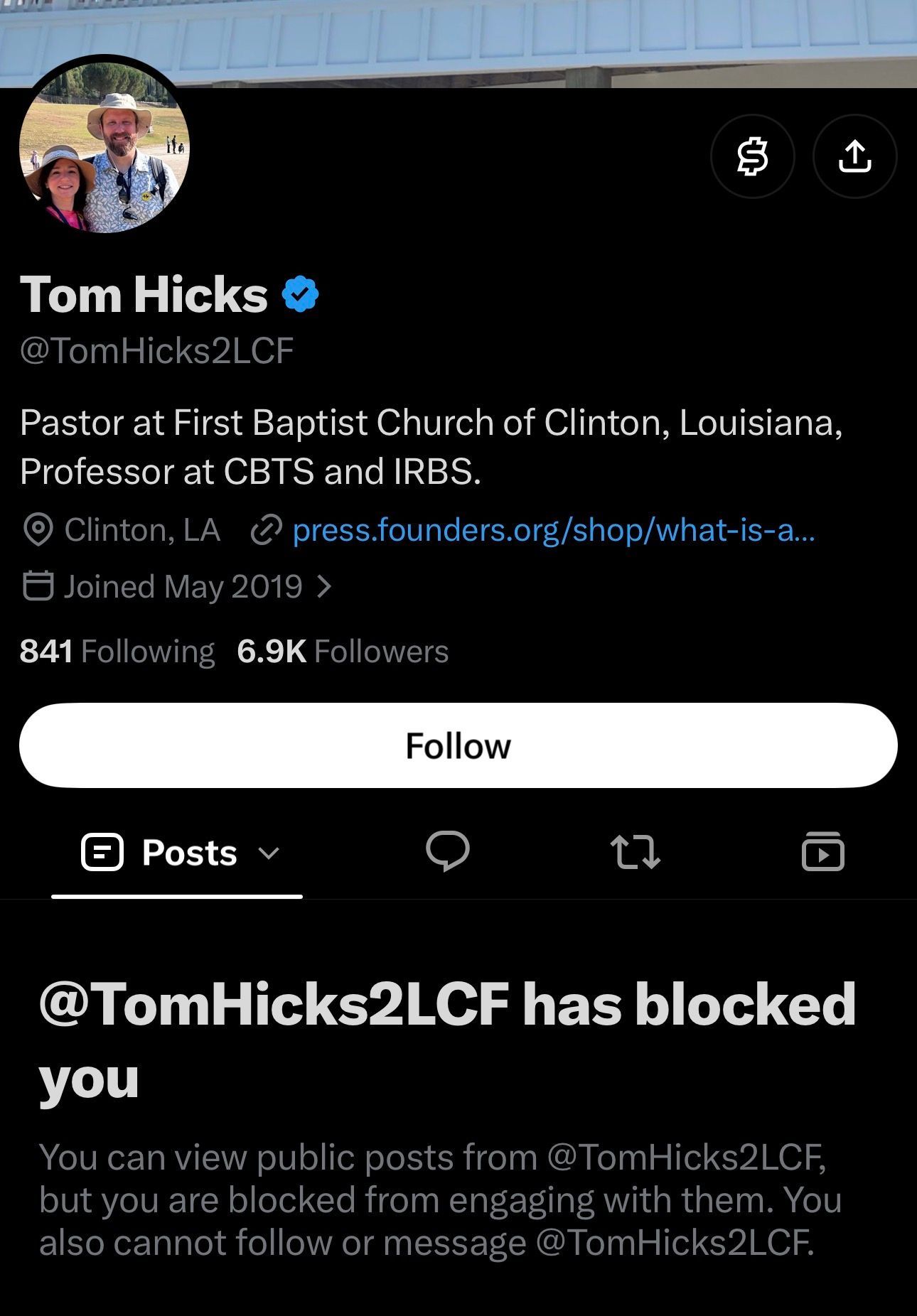
The author of What Is a Reformed Baptist? gives baptism four senses — but the engine is allegory's, and his own confession already ruled on it. Tom Hicks — a confessional Reformed Baptist pastor whose very handle, @TomHicks2LCF, flies the Second London flag — recently offered on X what he weirdly called "the fourfold sense of Christian baptism." Four numbered senses, each pinned to a medieval label: immersion as a sign of union with Christ (literal); a sign of Christ's death and resurrection (allegorical); a sign of the believer's death to self and new life (tropological); a sign of the believer's passing from this world into the next (anagogical). Patrick Schreiner — author of The Four Senses of Scripture, the most prominent recent case for recovering the quadriga — welcomed it: a smile emoji and a "thank you" GIF. The gesture is light. It is also telling, and it is why this small thread from X repays a longer look. The author of the retrieval's flagship book has just cheered the fourfold method as it steps off the page. What was a claim about how biblical texts mean is now applied, with the movement's blessing, to how a sacrament means. I want to be careful not to pay this the wrong compliment. One could call the post creative and mean it warmly. It seems as if many confessional Reformed Baptists do. But the creativity is the whole problem, not a mitigating grace. A hermeneutic is a discipline: it constrains what a thing may be taken to mean and tells you when you have gone wrong. A heuristic is a generator: it prompts you to produce, and it never runs dry. The fourfold scheme, turned on baptism, constrains nothing. It generates — four slots, and an invitation to fill them. That a godly and able pastor can fill them so readily is not evidence the method works; it is evidence of what the method is. A scheme that can find its four senses in a text, in an ordinance, in a hymn, in a handshake, is not discovering four senses in any of them. It is running its apparatus, which will always yield four, because yielding four is what it was built to do. Not a bug — the feature. There is a name for the faculty at work. Pareidolia is the mind's readiness to see a face where there is only cloud; apophenia, its broader cousin, is the readiness to see connection where nothing is in fact connected. The quadriga laid over a sacrament is apophenia in its Sunday clothes — the familiar fourfold silhouette projected onto a subject that never asked for it. Baptism is not a text with a literal sense and three spiritual ones stacked above it. It is one sign, and it signifies richly: union, death and resurrection, new life, the hope of glory — all of it whole and undivided in a single thick redemptive-historical reading of the texts that give it (Rom. 6:3–5; Col. 2:12; 1 Pet. 3:21). Sorting that one meaning into four medieval bins does not enrich the meaning. It multiplies the bins. And then the thread did the argument's work for it. A reader, Mark Harrelson, noticed a gap: "5. For remission of sins. You missed that one." The fourfold scheme had left out something the Nicene Creed itself confesses of baptism — and a fifth item is an awkward thing to hand a fourfold sense. Hicks's answer has real theological content, and none of it is wrong: Christ procures remission at the cross, faith is the hand that receives it, and baptism asserts and confirms it to the believer. Hold that sacramentology; it is sound. Then watch what the method makes him do with it. Remission, he said, is "contained in the allegorical sense." The four senses did not produce remission; challenged, they absorbed it, folding a fifth doctrine into a slot already holding another. That is not a fourfold reading yielding its riches. It is an elastic container stretching to swallow whatever the objection supplies. If the allegorical sense can take on remission after the fact — remission, which has no quarrel with the "death and resurrection" already sitting in that bin — then the "senses" are not distinct compartments of meaning the sacrament yields. They are labels roomy enough to relabel. Press them and they expand; and a scheme that expands on demand has stopped dividing anything at all. Remission was never a missing fifth sense. It was already inside the one meaning of baptism, exactly where union and new life and hope already were. The category error is the surface. The deeper problem is confessional — and here the irony turns tragic. And the tragedy is only multiplied by however many Reformed Baptists it influences to downplay or contradict the this foundational confessional hermeneutic. Hicks is no bystander to the Second London; he wrote the book on it. In What Is a Reformed Baptist? he argues that Reformed Baptist identity is confessional identity — that to be a faithful Reformed Baptist is to hold the historic confessions, and the Second London above all. The man who taught a generation that being Reformed Baptist means holding this confession has now read baptism in a way the confession forecloses. He cannot wave the objection off, because it is his own standard, in his own book, that raises it. The Second London, with Westminster, declares that the true and full sense of any Scripture "is not manifold, but one." Those four words do logical work. "Not manifold" is a denial — not a ranking, not a subordination, but a denial — of multiple senses as such. It denies the genus. And the quadriga, a theory of four senses, is the most prominent species of that genus. The denial of a genus necessarily contains the denial of its species: deny that Scripture's sense is manifold, and you have denied, in the same breath, the fourfold scheme that is manifoldness's flagship. To confess 1.9 is to have already declined the quadriga — and having declined it for texts, one has declined it for whatever else the fourfold silhouette gets projected onto next. This is no novel reading of the phrase. It is the plain force of "not manifold," and it is how the confessional tradition treated the question. Tyndale, Perkins, Whitaker, Leigh, and Turretin did not say the spiritual senses must be kept subordinate to the literal. They said Scripture has one sense. The men who wrote "not manifold, but one" were denying multiplicity, not tidying it into a hierarchy. The confession does not only deny; it directs. Having called the true and full sense "not manifold, but one," the same paragraph says how the one sense is found: it "must be searched and known by other places that speak more clearly" — Scripture set beside Scripture, read under the analogy of faith. That is the confessional method for establishing a doctrine's full meaning, baptism included: not four bins to be filled, but the gathering of every text that bears on the sign into one coherent teaching. Remission belongs to the doctrine of baptism not because it can be tucked into an allegorical slot, but because Scripture, searched and known — Acts 2:38 beside Romans 6, and the creed's "one baptism for the remission of sins" — teaches it as part of the one thing baptism signifies. The analogy of faith is intertextual, not fourfold. What was offered under the name of depth is a medieval grid standing in for the confession's own method — and standing in for it poorly, since the grid had no slot for remission until someone pointed out the lack. There is a stock reply that this is simply not what the Confession means. But asserting that "not manifold, but one" leaves room for other distinct senses is not an argument; it is the very thing to be shown, and it owes three unpaid debts: an alternative reading of the actual words "not manifold, but one"; historical evidence that the framers meant to leave a door open for distinct senses; and some account of the genus–species relation on which a man may deny multiple senses and keep four of them. Until those are produced, the four words stand. So — allegorist? Not by conviction. Despite recommending allegory to frame a spiritual sense for the doctrine of baptism, Hicks would reject the label, and the confession he wrote a book to commend rejects it for him. The charge was never that he holds allegory's creed. It is that he has borrowed allegory's engine and set it running against the very standard he taught the churches to keep. The soft retrieval of the quadriga keeps arriving at the same wall, and it arrives now in a new field. Whether the fourfold sense is offered for a passage or for the ordinance of baptism, the confessional verdict does not move. The waters are rich — rich with union, death, resurrection, new life, remission, and the hope of passing through the last judgment into glory. But that is the fullness of one sense, not the sum of four. There is a leaven here, and it is spreading. The manifold sense of Scripture, long resisted among Baptists, has unfortunately found a welcome among some Reformed Baptist pastors and seminary professors — and now it has jumped the tracks a second time, from the senses of a text to the senses of a doctrine. A fourfold sense of baptism today; a fourfold sense of the Supper, the church, the covenants tomorrow. Each step is greeted as recovery, as depth. But none of it is the confessional framing of the analogy of faith, and a little leaven leavens the whole lump. What spreads here is not a retrieval. It is a grid mistaken for a method, and a fad mistaken for a tradition. It may be someone's tradition. But not ours. Heuristic, not hermeneutic. Not manifold, but one. We distinguish. POST SCRIPT... Pastor Tom kindly unblocked me and replied to my X article: "Thank you for the post and the generous interaction. Allegory in the medieval usage was often severed from the meaning of the text and generated fresh meaning independent of the what the Word of God actually said. When the Reformers opposed allegory, that is what they opposed. But at other times, the Reformers employed allegory, but only when it was anchored in the one meaning of the text. Benjamin Keach was a faithful English Particular Baptist pastor who signed the Second London Confession of Faith. He wrote a massive interpretive tome titled Tropologia in which he proceeded to open the allegorical/typological, metaphorical, and tropological senses of Scripture. You can research it using AI and Google. He did not believe the one sense of Scripture is limited to the literal sense but expanded to typology and allegory and tropology. The same method of interpretation is evident from the preaching of Charles Spurgeon (often maligned by literalists). But these Reformed Baptist brethren didn't see any conflict with our venerable confession because there isn't any. It is found throughout our Reformed and Particular Baptist heritage. Tolle lege. The procedure of looking for the meaning of the text, how it points to Christ, how to apply it, and how it gives us hope for the future, arises from studying the way that Jesus and the apostles themselves studied the Bible. While I don't have space to work it out fully here, consider just one example from the author of Hebrews which is Paul, in case you were wondering. :) See Hebrews 12:5-6 and the manner in which the preacher handles the biblical interpretation of Prov 3:11-12. Context shows a fourfold sense. First, there is the plain sense. This is the truth that God trains or disciplines His sons. Second, there is the Christ-centered sense. God led Christ to the cross (Heb 12:2), and Christ learned obedience through suffering (Heb 5:8). He did this for us as our substitute and example. Third, there is the applied sense. God loves us, Christ teaches us how to suffer in love; therefore, in light of Christ, we can embrace suffering and persevere in love without becoming weary or fainthearted, knowing we are being made like Christ (Heb 12:11). Fourth, there is the final or heavenly sense. The goal of our training in sanctification is ultimately to see the Lord (Heb 12:14). Many other such examples of the Bible's interpretation of the Bible in this way could be shown. There is only one sense of the text. But that one sense is often though not always multilayered with many necessary implications." To which I replied: "Appreciate you for unblocking me to exchange replies. While some people decry this app, i find you get what you invest in it. Your input is greatly appreciated. I understand you may write more wherever you choose is best. My good faith yet pointed response will be a short list of where I consider you unhelpfully and sloppily blurring the lines logically, biblically, and confessionally: The first and most obvious: the 4fold sense as a tool for reading texts, versus interpreting a doctrine (e.g., baptism). A figure of speech, versus a second sense. Typology, versus invented allegory. Preaching a text, versus interpreting a text. Rejecting a method’s abuses, versus rejecting the method; illicit to overlay even the quadriga’s structure on our confession. And a big one: the implications of one meaning, versus four different senses or meanings." Please, stay tuned and be on the lookout for an episode of the Urban Puritano Podcast for a discussion of these issues.
By Roberto Gazga August 9, 2026
The body content of your post goes here. To edit this text, click on it and delete this default text and start typing your own or paste your own from a different source.
By Urban Puritano August 8, 2026
The body content of your post goes here. To edit this text, click on it and delete this default text and start typing your own or paste your own from a different source.

Check the Urban Puritano Shop