Urban Puritano • September 9, 2023

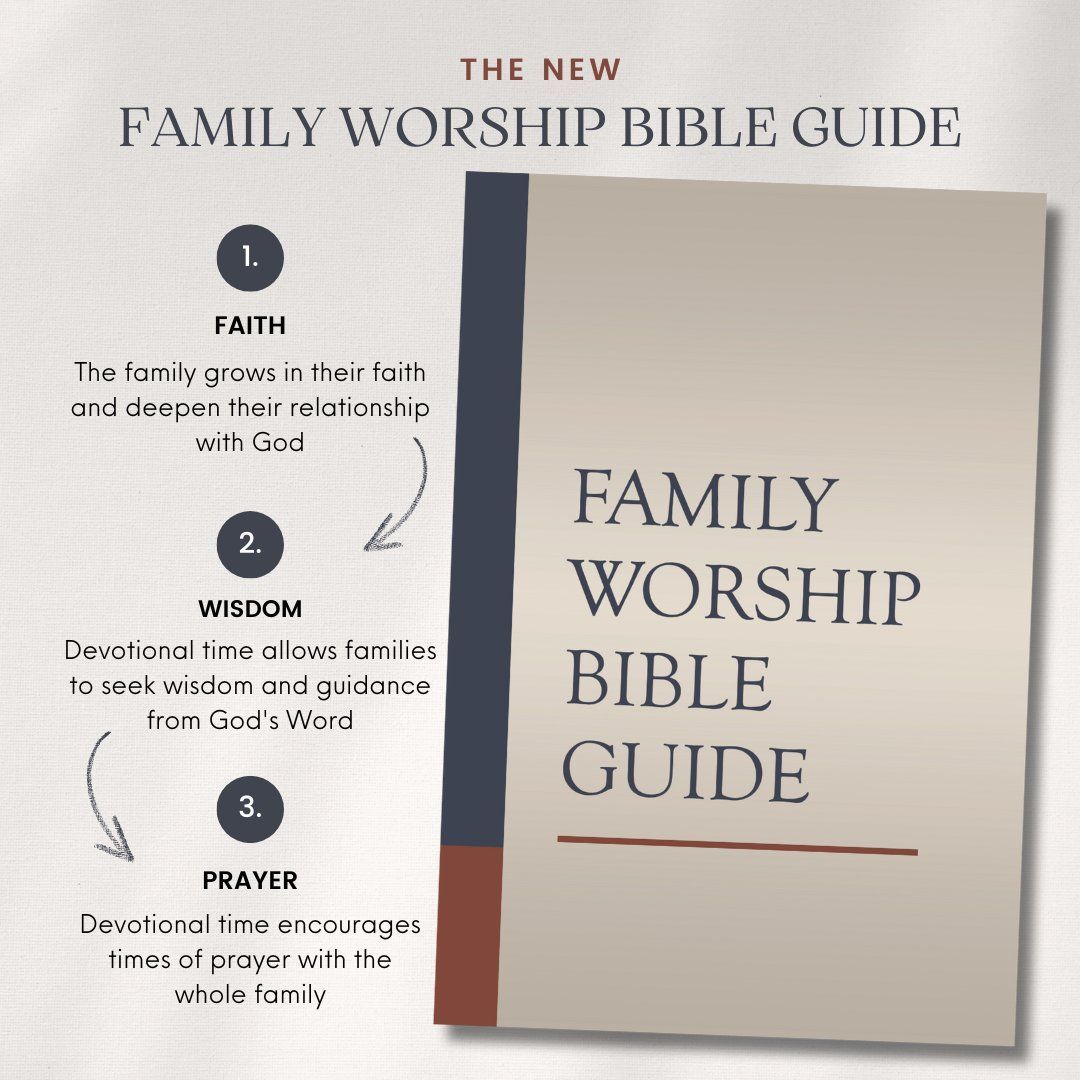
Family Worship Bible Guide
FAMILY WORSHIP GUIDE URBAN PURITANO

The Family Worship Bible Guide:

Laying The Foundation for Transforming Your Home


Let's be real. Family worship is a little known subject among evangelicals.


Family Worship is more known and practiced among Dutch Reformed denominations than in run of the mill evangelical denominations. Anecdotally speaking, I've known and worked closely with Presbyterians in my life, and although it's a known subject, it isn't practiced as much as you may think. Same goes for Reformed Baptists. But overall, this situation is changing as more resources are produced. 


Family worship is having a renaissance of sorts. One reason is the decaying culture surrounding us. Christian parents are being convicted to take full advantage of their relationship with their children and lead them devotionally to attend to the voice of God as found in the Scriptures not only on the Lord's day but every other day too. Whereas before family worship was looked as being unnecessary or a spiritual luxury, more and more evangelicals are looking at it as indispensable in our current cultural climate. 


But what is meant by family worship? In essence, family worship is the daily practice of parents designating a time to lead their children to read scripture, pray, sing spiritual songs for the purpose of creating conditions conducive for robust faith and spiritual growth. I say parents because if the husband and father is not present, the mom is in charge. Then again, there are single dads, too. 


Families are so diverse nowadays. Family worship may be conducted by one parent if only one parent is believing. In any case, family worship is intended to be daily, or at least consistent. Does dad work late hours? Does mom work outside the home? Coordination of schedules may present a challenge. Parents have to come to the point in their lives where they are persuaded that to prioritize their own and their children's spiritual lives, they will have to commit themselves to consistently being together to attend to their spiritual needs on a regular basis. 


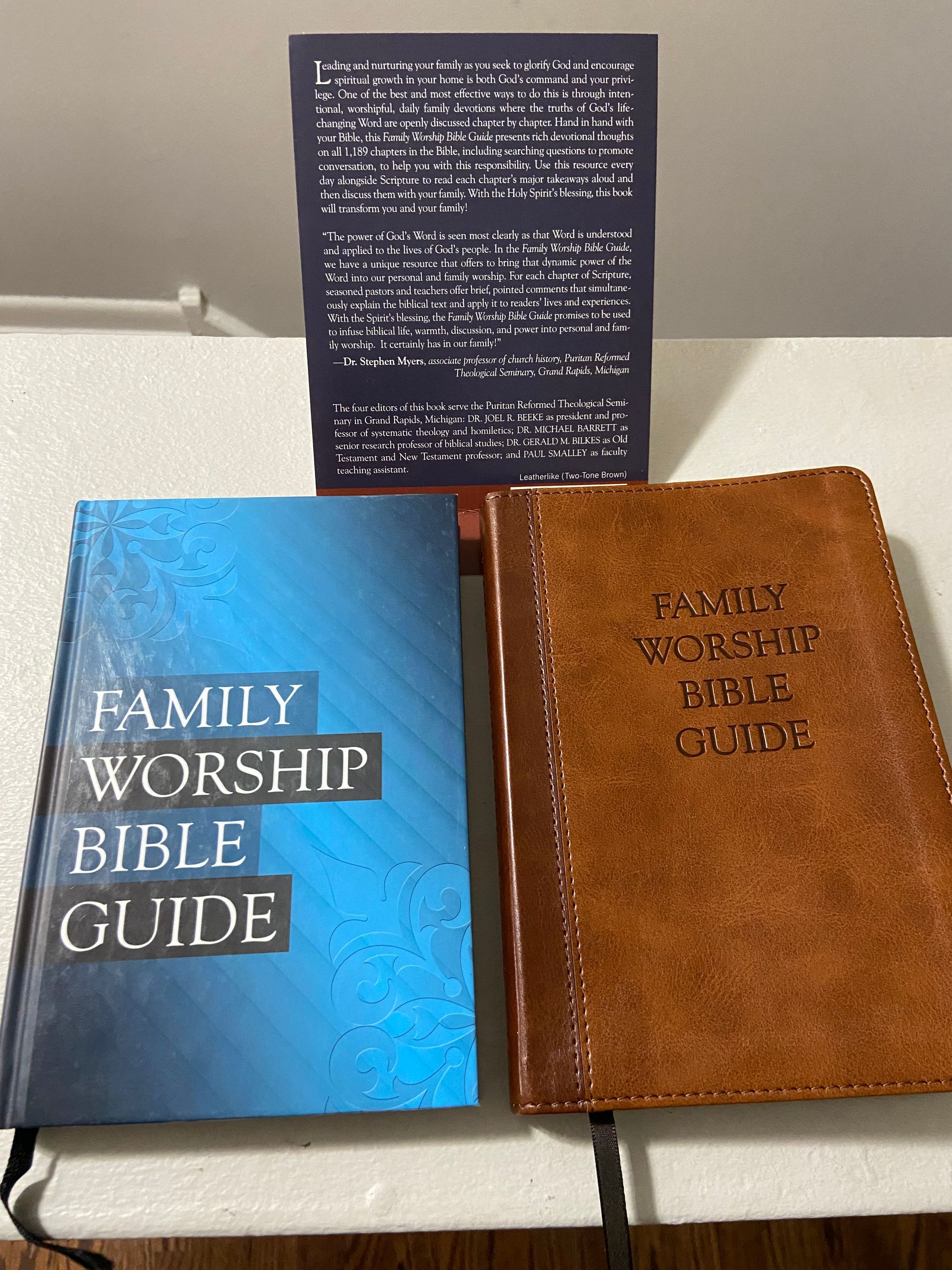
What direction or help can a father obtain for family worship? One immensely helpful resource is a little book published by Reformation Heritage Books called The Family Worship Bible Guide. Full disclosure: Reformation Heritage Books generously provided me with a free copy of this book in a synthetic leather edition that was recently released. This blog post is my honest review. I hasten to add that I bought the hardback cover edition of this book when it was first released several years ago. I even used it in adult Sunday School class and consulted it for sermon applications. 


To the best of my knowledge, the Family Worship Bible Guide is a section of the Study notes from the Reformation Heritage King James Version Study Bible released in 2014. Now, although I don't own that Study Bible, I did buy, (once it became available) the same Study Bible in Spanish called Herencia Reformada. Interestingly, then, the same notes for family worship are found in the Spanish version of the Study Bible, and it was especially convenient for me because I was a member of a Spanish speaking congregation. So, I have been a fan and supporter of this resource for several years. 


In a sense, it's like having Dr. Joel Beeke as a coach beside you, guiding you every step of the way. He tells us in the introduction, “Family worship will require some preparation.” Let me share some bullet points. In broad strokes, such preparation includes: 


  • praying for God's blessing upon family worship,
  • having your Bibles ready
  • having a Scripture passage preselected
  • having the Catechism of your choice, or perhaps something like the Pilgrim's Progress for discussions
  • choice of Psalms or hymns to sing
  • picking a place to gather like the dining room table or the living room
  • setting the times for family worship
  • guarding those times for family worship
  • Aiming for brevity


family worship


Dr. Beeke goes on to offer deeper spiritual support for daily instruction in the Word of God, daily prayer before the throne of God, and daily singing to the praise of God. The father has no excuses on how to implement family worship, even if he adapts some of the suggestions to his circumstances. For example, some families may not be able to do family worship twice a day as mentioned in the introduction. Fine, so do it once daily. 


Now, my two cents differ slightly from Dr. Beeke's suggestions, but only slightly. I just want to acknowledge in my experience and neck of the woods, there are a lot of single mothers, fathers and grandparents or extended family members raising kids nowadays. Ideally, this shouldn't be the case, but it is. Unfortunately, there are a lot of single mothers out there. Some are immature and say they don't need a man. These claim that they function as both mother and father by necessity. Others who are a little wiser recognize that they can't fill a father's shoes. This situation highlights a great two-fold need in the church today, at least in North America. It's really a symbiotic relationship between sound preaching the whole counsel of God and family worship. 


The preaching of the Word, as the experimental means of grace is sorely lacking. This sort of preaching gives dry bones life not only to individuals but to families. Experimental and applicatory preaching that glorifies God by opening the Scriptures so that the Spirit can open the doors of the homes and produce a divine work of family reformation that will result in family worship. This may lead to Apostolic prescriptions being obeyed like the command of older, wiser ladies to help the younger ladies out (Titus 2:3-5). 


Although it is quite common to hear in contemporary preaching on the failures and sins of men from the pulpit, it is almost as if addressing the unique failures and sins of women is the third rail of pulpit ministry in America. None of us is without sin. The purpose of teaching and preaching is to benefit believers and glorify God, and that will be seen and felt by men, women, and children. Not in the abstract, but in the nitty-gritty of households. And it takes blood, sweat and tears to accompany preaching and teaching. As Dr. Beeke said in the introduction, not only Abraham's faith, but his obedience as well. 


Along these lines, I remember teaching an adult Sunday school class a few years ago. I had my Herencia Reformada Study Bible and we were in a parallel teaching series to the preaching series. Ephesians 5 and 6 received much attention over the span of weeks. The family worship notes came in handy for the lessons. Note #3 on Ephesians 5 was very apt for my audience. It says, “Marriage exists to show the glory of Christ. It is God's display case for the beautiful relationship between Christ and the church. Husbands and wives have a high calling. Commit yourself to serve your spouse as God commands in His Word. Whether your marriage is sweet or sorrowful”


This note should resonate with all Christian married couples. Marriage isn't always sweet. It's sometimes sorrowful, but neither the lack of sweetness or abundance of sorrow is the standard by which you measure Christian marriage. What better commendation can I give to study notes coming from a Bible like this? They are as honest as the Bible itself is. The Family Worship Bible Guide is full of experiential, applicatory insights, helpful not only for family worship but for teaching and preaching. I wholeheartedly recommend it for your family and church. Soli Deo Gloria.


Check out EPISODE 21 for an abridged reading of John Bunyan’s Pilgrim’s Progress!


family worship guide URBAN PURITANO

Share

By Urban Puritano January 6, 2026
"If the rule you followed brought you to this, of what use was the rule?" Anton Chigurh "Until the four-fold method becomes critical of its own theoretical foundations and develops a hermeneutical theory adequate to the nature of the text which it is interpreting, it will remain restricted--as it deserves to be--to the romanist guild and the papist adjacent academy, where the question of truth can endlessly be deferred." (Not David Steinmetz) Introduction Some things are so fundamentally flawed, coming up with alternatives should be easy. Some things are so fundamentally flawless, coming up with refutations should be impossible. The quadriga is one such example of the former while the single sense of Scripture is an example of the latter. But times have changed and some Protestant scholars are increasingly giving Rome's official hermeneutic the right hand of fellowship. There has been too much intellectual hospitality in Protestant/Evangelical seminaries extended towards the viability of the quadriga as a model for Biblical interpretation. So much so, this medieval method is being retrieved or rehabilitated under the guise of a Christocentric hermeneutic or an Apostolic way of reading the Scriptures. This represents a dishonest downgrade for Evangelical theology in general and for Reformed confessional theology in particular. It is a woefully inadequate critical appraisal of the quadriga at best and a spiritual betrayal to be repented of at worst. A representative sample of two Reformed confessions of faith are united in confessing " the true and full sense of any scripture...is not manifold, but one ". Both the Westminster Confession of Faith and the Second London Baptist Confession of Faith use the same language to deny the manifold sense of Scripture envisaged by the quadriga and affirms Scripture's single sense repudiated by the quadriga. Soon, there will be a full court press hailing the quadriga's supposed hermeneutical virtues. What was once confined to a few lecture halls of Protestant academia will be delivered far and wide with the upcoming publication of a book endorsing the quadriga for Evangelicals. Dr. Patrick Schreiner's book on the subject will probably be endorsed by a wide cross section of academics on both sides of the Tiber. Whether it's a full throated retrieval of the quadriga or only a limited one for its integration into Protestant Biblical interpretation remains to be seen. Neither possibility is hermeneutically viable. One thing is for sure, though. The ground has been prepared for some time by some who have learned and taught its tolerance as a benign model of hermeneutics consistent with Biblical sensibilities. Much intellectual hospitality has been given to the quadriga by certain retrieval minded Evangelicals. Instead of the temporary hospitality of critical appraisal, the quadriga has moved in. What also remains to be seen is if the doctrinal deliverances of the quadriga will make their way inside. Time will tell if this has a leavening effect. Acceptance of the quadriga by Protestants, Evangelicals, and confessionally Reformed isn't viewed as that big of a deal. What is the quadriga's "Triage" score? Any alarm can be assuaged by a consideration of its long track record, right? As David Steinmetz has stated: "The medieval theory of levels of meaning in the Biblical text, with all its undoubted defects, flourished because it was true, while the modern theory of a single meaning, with all its demonstrable virtues, is false." What, then, are the Quadriga's defects that lead the Reformers and their confessional heirs to enshrine, not its embrace, but its rejection? The short answer via YouTube by yours truly: https://youtu.be/p8g9pQi2pUs?si=XwKVFvg8Y20yDyF0 The short answer via podcast: https://share.transistor.fm/s/89564a04 (The long answer will be summarized in this brief outline that comprises this blog piece. Links to the longform podcast episode at the end). Although you can't just pick up the Bible and leisurely read it like any other book, you cannot read it rightly unless you read it similarly to most other books every step of the way. After all, to read is to interpret and to interpret is to read rightly. This prompts some questions: How should a sincere believer, whether learned or unlearned proceed to read Scripture rightly? Are the quadriga's defects prohibitive rationally, Biblically, and confessionally? Some, with varying confessional commitments, like Mitchell Chase, Brandon Smith, Craig Carter, Peter Leithart, Matthew "Tossed To and Fro" Barrett, Luke Stamps and others have to a greater or lesser degree found the Quadriga to be a legitimate means to understand the written Word of God in all its polyvalence. Who can blame these academics? There is a strong tradition of interpreting Holy Writ, at least academically, in the fourfold sense. Whereas before such a method was taught and promoted among Roman Catholic academics, it is increasingly being tolerated or even touted by Evangelical academics sometimes under the guise of Christocentrism or reading the Old Testament like the Apostles did. Because of this, many young scholars and their younger seminarian whipper snapper acolytes are ignorant of the quadriga's deficiencies. This represents somewhat of a pyrrhic victory snatched from the jaws of rational, Biblical, and confessional defeat. Major Reformed stalwarts of the past like William Perkins commonly held the medieval Roman Catholic quadriga in disdain to such an extent he averred that "her device of the fourfold meaning of the Scripture must be exploded and rejected." ( Art of Prophecying ). Nowadays? Not so much. The quadriga is being massaged and repackaged without batting an eye. In a Room for Nuance interview promoting a previous work of his that dipped its toe into the quadrigan pool for interpreting the Transfiguration, Dr. Patrick Schreiner says : PS: "What I love about the Quadriga, the fourfold sense, is there's an order. You first start with that original question." Host: "So, it's not just four. You actually have to begin with one." PS: "That's what I'm kind of saying. And I do think that's what people throughout church history have said. There is actually, you begin with the literal sense. It's all based on literal sense. Then you go to the Christological, allegorical sense. Then, this is what I think is so helpful. Then you ask the question, what does it mean to me? And I love this because there's actually a gospel shape to it. Because you don't ask what it means to you until you've gotten to the gospel message of what is Christ. So, the danger in asking, what does it mean to me, is you moralize the text. You don't actually get to the gospel. But if you ask these in the right order, you actually get, oh, this applies to me as I am in Christ. As I am forgiven in Christ, then the text begins to mean something to me, because this is actually divine word, which speaks to me. We are still part of the covenant people of God. So this wasn't just written to people long ago. It was written to us because we have dual authorship here. We are the authors, the human authors and divine author." These types of remarks reflect an embrace of the medieval Catholic couplet summarizing the quadriga: "The literal sense teaches historical events, the allegorical sense teaches what to believe, the moral or tropological sense teaches what to do, and the eschatological or anagogical sense teaches our ultimate destiny." Instead of representing a continuity with classical Reformed rejection of the quadriga, these sentiments represent a discontinuity of the confessional Reformed rejection of the quadriga. What is the Quadriga? The quadriga is a medieval method of biblical interpretation crystallized in the Roman Catholic academy, whereby a dualistic bifurcation takes place. There is in Scripture a literal sense and a distinct spiritual sense. The literal sense consists of whatever meaning the words of Scripture render in ordinary ways derivable from a consideration of linguistics, philology, semantics, grammar, syntax, and historical considerations of its content. The latter spiritual sense encompasses three components distinct from the literal sense and each other, thus totaling four in all. These 3 further distinct domains of non-literal, spiritual meaning are: • Allegory or figurative signs used to signify something else • Tropology or moral lessons and imperatives • Anagogy or future focused eschatological hope These three senses encompass the spiritual meanings of Scripture statements in contrast and contra-distinction to the literal sense of Scripture. Hence, the name of this method of Biblical interpretation is the quadriga, which is a word that comes from the Latin for a chariot drawn by four horses abreast. The metaphor is apt since it is not four horses in a row one after the other, but four horses abreast or at each other's side with no one horse overtaking the other. Proponents, both medieval and modern, perceive in the quadriga interpretive virtues emerging from the polyvalence of Scripture itself. Dr. Richard Muller, for example, describes (not prescribes) how the quadriga tracks with "the character of the relationship between medieval exegesis and medieval theology, between sacra pagina and sacra theologia. The text of Scripture in its fundamental meaning is a historia salvationes, from which teaching can be drawn to address Christian faith, love, and hope. The history of the text itself in its literal meaning, together with its doctrinal implications, correspond with the four elements of the quadriga--while the quadriga or fourfold exegesis, in turn, corresponds with the fundamental needs and interests of theological formulation." ( Post-Reformation Reformed Dogmatics, V. 2, p.22 ). Muller describes it all so neat and tidy. It almost seems sinful to question the quadriga's historical development, from its earliest two senses to three senses, to its eventual final four senses. And if one goes back further to the quadriga's supposed source in Holy Writ itself, it would certainly seem even more sinful to question the contrast between the life-giving spirit and the life-killing letter as a Biblical warrant for what the Quadriga, as an interpretive paradigm, is and seeks to do. It would be quite an irony if of the many false deliverances of meaning in the quadriga's history of interpretation, the attempt to justify it from 2 Corinthians 3.6 turns out to be a stretch. Bugs or Features? What, then, are the quadriga's defects? In no particular order, let me suggest the following. First , the quadriga's conceptual clarity as a hermeneutical or exegetical resource should be critically examined . Is it best hermeneutical practice to approach Scripture assuming it will yield four distinct senses? This seems to be an unwarranted assumption on its face since exegetical interpretive processes should only seek to draw out from the text whatever sense or implications have warrant, not imposing a sense from the interpreter's pre-existing mental schema. In medieval times, the quadriga's schema was fourfold sense grid. In modern and postmodern times and methods, the schema will differ. Must the medieval quadriga reject postmodern methods or perhaps incorporate them and add more senses to the scripture? If it is axiomatic that the quadriga's fourfold sense provides best practices nowadays, why didn't the previous periods of church history with two or three senses of Scripture have staying power? Does the evolution from two to four senses of Scriptural meaning demonstrate progress in the art and science of Biblical interpretation, but such progress is no longer possible? It would seem chronological snobbery is a possibility not only towards the past, but towards the future. However, whatever number of senses one holds to for a manifold sense of Scripture, the defect in conceptual clarity remains: hermeneutics and exegesis is about drawing out textual meaning, not possessing it before the start. Second , as a consequence of the first, the quadriga seems fundamentally anti-reader . I mean this as an objective claim or reason. I know many Protestant evangelical scholars have written testimonial articles, essays, and a soon-to-be-published book on the quadriga's hermeneutical viability and virtues. Most of these testimonies are in the subjective realm. Reading homilies from the Church Fathers and being enraptured by their theological depth has opened new vistas of biblical truth for such academics and their young whippersnapper acolytes. However, not distinguishing properly between a Church Father's rhetorical skills in weaving biblical allusions to audience adaptations and applications, or worse, failing to distinguish between compositional allegorical affordances in the text of Scripture (very few, if any genuine) for interpretive allegorical imaginations from the minds of the Church Fathers (an abundant number) is a recipe for failure to read Holy Writ rightly. The reader of Scripture is better served by upholding in his mind only what can be justifiably warranted by the text of Scripture itself. Caused and composed by the Divine Author and human authors, respectively, the reader was meant to encounter and draw out meaning from all its features and compositional affordances. That's how communication works, and the Scriptures, as Divine Communication, work no differently. Communication does not work by statements with four distinct senses. As such, the quadriga is defective by being fundamentally anti-reader. Third , the quadriga is defective by militating against the perspicuity of Scripture. Not only is the issue of how man must be saved clearly read throughout Scripture, but the general tenor of the Bible is clear enough to the average person to catch. Whether learned or unlearned, the reader of Scripture can clearly discern the variety of textual terrain and what the biblical landscape displays in all its diversity of stylistic traits and its rich abstract theological features. The Bible may vary in genre and style, but the character of Scripture's content is fundamentally pro-reader by being generally clear. Scripture’s content and overarching storyline composed of myriad “stories, examples, precepts, exhortations, admonitions, and promises” (William Ames, The Marrow of Theology , 187–88) concerning God’s redemptive purpose and man’s salvation are sufficiently “clear and evident.” Both scholar and layman can by the same means arrive at the answer to how a holy and just God can bless rebellious, sinful mankind with salvation. As it was before for shepherds, warriors, royalty, and fishermen and as it continued to be for monks, maidens, lawyers, and tinkers, so the Bible’s message continues now―sufficiently “clear and evident” to all who would apply “a due use of the ordinary means” (2LBCF 1.7). How? By a due use of the ordinary means of learning. A critical and judicious use of both inductive and deductive interpretive tools can be learned at a relatively young age and confirmed and expanded upon as the believer grows in wisdom and knowledge of God's Word. The inductive analysis of Scripture afforded by comparing Scripture with Scripture, especially unclear portions with clear portions (i.e., the analogy of Scripture), takes into account the text’s diverse features without bifurcating the literal from the spiritual, the Old Testament from the New Testament, or a single passage from its canon-wide context. For this reason, most talk cautioning against atomistic reading of Scripture is misguided. At least for the confessional Calvinist since there is no dualistic distinction between the letter and the spirit, the Old Testament and the New Testament, and a single passage from its fuller meaning. After all, the deductive synthesis of Scripture afforded by the uniformity of Scriptural teaching judiciously arrived at takes into account the resulting system of doctrine emerging from the whole of Scripture (i.e., the analogy of faith), which is the confessional Reformed Christian’s “rule of faith and life.” This respects both the human and divine dimensions of the Bible. In sum, we can always delve more deeply into a text of Scripture as long as we understand a text’s meaning isn’t marooned from the rest of the canon much less assume a necessary dualism of letter and spirit in the manner the quadriga upholds its manifold sense. Remember, as we do compare Scripture with Scripture (analogy of Scripture), we accumulate biblical evidence. Implications are validly drawn out, possible interpretations are eliminated, and control beliefs are modified and subjugated to the total truth of God’s Word. Because Scripture cannot be broken (John 10:35), what emerges as texts supplement texts in a holistic, systematic fashion is a uniformity of teaching (analogy of faith). The analogy of faith cries out to us to reach for the baton of well-established and judiciously arrived-at Scriptural doctrine and continue running the race. Fourthly , the fourfold method of the quadriga has inherent problems for rational, exegetical, and logical procedures to draw out meaning. If all of Scripture is assumed to have these four particular domains of meaning, exegesis is more akin to a foregone conclusion in search of data. The fourfold method draws out meaning by putting it there to start with. In other words, exegesis is now become eisegesis. Methodologically, the fourfold approach is nothing more than transposing interlocking spiritual senses, the allegorical, tropological, and anagogical, onto the literal sense. It pays lip service to the foundational reality of actual events, persons, places, propositions, and relationships in the text of Scripture to get to the higher level, spiritualized senses. Oh yes, I know, the medieval and now some of the moderns who give the quadriga a pass are quick to distinguish, in theory, the allegoria in factus from the allegoria in dicta or verbus. But this labeling of the letter of Holy Writ and the spirit of Holy Writ is no rational help in the process of drawing out the sense of scripture. The rubber does not meet the road when the need is created for a partitive exegesis of sorts , because the dualistic bifurcation of God's word is held on to. Instead of opening up hermeneutical vistas for fruitful exegesis, the quadriga only serves to double down on dualism and bifurcation of the literal from the spiritual, when no such division exists. Remember, the spiritual sense is composed of three distinct domains of meaning, distinct from each other and the literal sense of Scripture. The correct and vital posture is to recognize and remember the following: The Bible is at once nothing more than literal and nothing less than spiritual. By way of illustration and analogy, consider the incarnation. Dr. Iain Proven is quite correct when he states, "I do not see Scripture as primarily human in nature, any more than I see Christ as primarily human in nature. I see Scripture as fully human in nature. And then also as God's word to us" ( "Become a Text Critic": The Reformation and the Right Reading of Scripture ). It is this "seriously literal" approach (as Provan calls it) of the Reformation that alone receives the revealed, inscripturated Word of God as His communicative intent meant it to be received. Moreover, when the Bible's hypostatic union of sorts isn't recognized and remembered, and instead bifurcated, such as in the case of the quadriga, interpretation inevitably results in ambivalence on any given meaning of the four senses. This ambivalence in interpretation takes the form of interpretive subjectivity. In Reformed and confessional circles, it is often snickered at and found worthy of mocking to hear of a Bible study where the teacher goes around and asks attendees what a text under consideration means to them. But the quadriga is more ambivalent to the four senses than is acknowledged and more subjective than is admitted. Especially by some Evangelical and Reformed professors and pastors who are giving it a pass as a viable option for biblical hermeneutics. St. Bernard, interestingly and unironically, presents the problem of ambivalence towards the four senses bluntly. He stated: "I know that I have explained this passage more fully, and in another sense, in my book Upon the Love of God. And if it shall please any of you to read that, he can decide whether of the two is to be preferred. A prudent person will not, I think, condemn the giving of the two senses to the same passage, provided that each appear to be grounded in the truth, and that charity, which is the rule in interpreting scripture, shall edify the more persons, inasmuch as there are a greater number of truthful senses, which each may apply to his own special need. For why should that be found faulty in the interpreting of Scripture, which we see is industriously practiced in other things? To how many different bodily uses, only to take one example, do we put the element of water? In the same way, a person is not to be blamed who gives divers senses, fitted to the various needs of souls, to a passage of Scripture." (Saint Bernard of Clairvaux's Sermons on the Song of Songs as found in Life and Works of Saint Bernard, Abbot of Clairvaux, edited by Dom John Mabillon and translated into English by Samuel J. Eales, V. 4 , 310, 1889–1896). Ironically, this quote from St. Bernard might be considered to be a gold mine for some academics seeking to give the quadriga a pass. Articles, interviews, books, and the authors of such are twisting themselves in knots bending over backwards to say that the quadriga is simply attempting to apply the literal sense. However, this just demonstrates that the quadriga is not only a potential, but an actual mine field of its basic logical defects. Hermeneutics should not conflate the sense of Scripture with the application of the sense of Scripture, should it? Confessionally Reformed Biblical interpreters should distinguish well to earn the respect to merit the verdict of teaching well . A thought experiment can be helpful to appreciate more fully what we're dealing with here in practical and logical terms. Bernard says as long as each appeared to be grounded in truth, prudence would not condemn the giving of two different senses to the same passage of Scripture. Now suppose he gave an allegoria in factus interpretation in the first case, but an allegoria in dictus or verbus in the second case. Suppose further that a different saint gives another allegorical interpretation altogether. As the allegorical senses multiply through the corridor of time, some become standard within a community. That's basically capital T tradition. But even though some allegorical senses become standard through tradition, are all the alternate senses that have accumulated over time just disposed of by the exclusion effected by the standardized interpretations? So, if you consider 20 centuries of church history, you can see within it 20 centuries of the history of biblical interpretation. Saint Bernard gives two senses of the same biblical passage, with four possible senses in all, with perhaps two types of allegory. Add to that more saints throughout church history, some more famous, some obscure. If all these saints do the same as Saint Bernard, the work of standardization is going to need some major help in arbitrating, not only multiple offerings per sense, but how many overlap and how many are united in their conclusions of the four senses of Scripture as a whole. The Magisterium has entered the chat. How else do interpretations of Scripture become authoritatively standardized? I won't make the lazy assertion that the quadriga leads to Rome. No, the quadriga is simply at home in Rome. To find it in Wittenberg, Geneva, or London is tantamount to finding Alistair Begg at a trans wedding bearing gifts. I mean, it's possible, just maximally inconsistent and weird. Truth be told, medieval tradition may also speak of the three non-literal spiritual senses of Scripture, each consisting of two additional types of meaning: open and mystical. Do the math now. T his manifold meaning model of biblical hermeneutics is more historical than veridical. Saint Bernard hints at another feature, not bug, in the quadriga's nature as a hermeneutic. On the heels of its ambivalence, in the form of subjectivity, is its utilitarian or pragmatic motivation or criteria. Again, certain evangelical and reformed voices, giving the quadriga a pass nowadays, often decry the Church's downgrade into pragmatism in ministry. But the same eyes that see this problem among broader evangelicals are blind to it in the quadriga as an interpretive method. I repeat St. Bernard, quote, "A person is not to be blamed who gives divers senses, fitted to the various needs of souls, to a passage of Scripture." This pragmatism in hermeneutics puts the applicational cart before the four horses. Bernard's pragmatic and utilitarian criteria for interpretive viability has had a long history. Over seven centuries before, Gregory of Nyssa argued: "Therefore, if indeed the literal meaning, understood as it is spoken, should offer some benefit, we will have readily at hand what we need to make the object of our attention. But, if something that is said in a hidden fashion, with certain allegories and enigmas, should yield nothing of benefit according to the readily apparent sense, we will turn such words as these over and over in our mind. This is just how the Logos that teaches us in Proverbs has instructed us to understand what is said as either a parable, or a dark saying, or a word of the wise, or as one of the enigmas. (Proverbs 1:6). When it comes to the insightful reading of such passages, that comes via the elevated sense, that is, the anagogical sense, we shall not beg to differ at all about its name, whether one wishes to call it tropologia, allegoria, or anything else, but only about whether it contains meanings that are beneficial." (from introductory section in Homilies on the Song of Songs where Gregory sketches his hermeneutical approach). Because of this, perhaps, in addition to the four senses, another sense should be added: the beneficial sense . Thomas Aquinas was no dumb ox when he famously taught that if the Scripture at the literal level speaks expressly of future glory, then the Scripture passage is only to be interpreted on the literal level. Bonaventure similarly said that if the literal level speaks of faith or of love, then a higher symbolic spiritual or typological sense needn't be sought further. Nicholas of Lyra said that it was useless to seek beyond the letter of Psalm 67 for a second sense because the literal sense of the psalm is already spiritual. So much for the superficial and incorrect interpretation of the letter of Scripture killing. Hermeneutically, not only does the letter not kill, but the letter is all we've got. Remember, the letter is the work of God's causation, just as much as the things recorded by it. No need to introduce manifold meaning of Scripture by the dualistic bifurcation of the literal and spiritual senses of Scripture. Lastly , under the fourth rubric of the Quadriga's inherent defects for rational exegetical procedures to draw out the Scripture's meaning , we note its ultimately arbitrary and capricious nature. What do I mean? Arbitrariness is the quality of willy-nillyness. Any such willy-nillyness can't long pretend to have a consistent rhyme or reason, much less a restraint of use in implementation other than the pragmatically beneficial. Capriciousness is the quality of a propensity to change as unpredictably as a Mexican girlfriend mad at her boyfriend. Any such capriciousness doesn't even try to pretend to have any rhyme or reason, much less restraint for its attitude and behavior. How can this be said concerning the quadriga? Shouldn't I be more respectful of this historical, pre-critical method of biblical interpretation, being given a pass, and even being rehabilitated and retrieved by erudite evangelicals in our day? Let that sink in. When you do, you will have to answer to whether your sensibilities and interpretive practices should be guided by any respect whatsoever for this pre-modern fourfold sense grid. If biblical interpretation must yield a fourfold sense of Scripture, why four ? This is arbitrary. If biblical interpretation must not always yield a fourfold sense of Scripture, why not ? This is capricious. Talk about Latina girlfriend vibes! How you feel about dating or a hermeneutical method, however, matters very little. The quadriga shouldn't even be friend-zoned. It should definitely be broken up with if she tempted you to give her a chance and just consider her manifold sense as applications of the literal sense of Scripture. After all, the same arbitrary and capricious nature for the quadriga's fourfold sense certainly obtains for revisioning her as a model for application. No method of biblical interpretation that is either capricious or arbitrary is rationally viable. The quadriga disqualifies herself as being a rationally viable hermeneutical method by being both capricious and arbitrary. The confessional reformed interpreter, on the other hand, by rejecting the quadriga's manifold sense of Scripture, experiences no downgrade in hermeneutics by adherence to the single sense of Scripture. This sense is ipso facto rational with no arbitrariness or capriciousness. This leads to the fifth of the quadriga's defects. It contradicts our Lord and Savior Himself as He states, "The words that I have spoken to you are spirit and life." (John 6:63). Moreover, he quotes Deuteronomy saying, "Man shall not live by bread alone, but by every word that proceeds from the mouth of God." (Matthew 4:4). Every word of Scripture is spiritual and life-giving sustenance. It's meaning is ipso facto beneficent with no dualistic bifurcation. Therefore, any dualistic interpretive framework, such as the quadriga, is a failure. Such dualism only serves to subvert and subordinate the objective letter to the arbitrary and capricious spirit, if such an interpretation is subjectively and pragmatically beneficial. Ultimately, this method lacks true virtue and is unworthy of respect because it contradicts the Lord Jesus himself. The words of Christ in all of Scripture are at once nothing more than literal and nothing less than spiritual. This leads to the sixth and final reason the quadriga is hermeneutically defective. The manifold sense of Scripture as an axiomatic framework shows itself to be an unstable and uncertain starting point for rational thought and speech. This medieval model of multiplicity of meaning front loads the Scripture with communication problems that simply aren't present in the text. Scripture never asks us to choose between the literal or spiritual. It never asks us to choose between a beneficial or non-beneficial use. It never asks us to be methodologically ambivalent. Much less does the Scripture ask us to access its meaning through arbitrary and capricious senses or applications. These outcomes happen because the quadriga guarantees them from the start. Therefore, it is not merely that the quadriga has a history of bad users. It is that the quadriga itself is a bad method. The real miracle found in looking at the history of the church's interpretation of Scripture as the quadriga was being developed and employed is that there was any truth delivered at all. I suppose even broken clocks can be correct twice a day. How then can communication via rational thought and speech be maintained? Only through the axiom of a single sense of Scripture. Only such a model or framework reflects and preserves the God-breathed, rational revelation of Holy Scripture. God saying something, anything, is simply Him communicating his thoughts propositionally. And while not all of Scripture's sentences are declarative, they are rightly understood to be the equivalent. Whether Scriptural words and thoughts are expressed properly or figuratively, their sense is singular. For all the aforementioned reasons, if the Scripture yields the quadriga's manifold sense, it can have no sure meaning. Such is the communicative intent of Scripture, and it does not return void. Interestingly, the framers and signers of the Westminster Confession of Faith and the Second London Baptist Confession of Faith took the single sense of Scripture for granted against the medieval quadriga and anything like it. They weighed the manifold sense and found it wanting. Not simply its many infamous abuses and supposed ascent into spiritual biblical interpretation, but the principle of manifold meaning itself. The quadriga as an interpretive method was in and of itself seen as irredeemable. As far as they were concerned, to be deep in the history of biblical interpretation was to cease to be quadrigal. Ultimately, it makes perfect sense (no pun intended) the single sense of Scripture holds confessional status for the truly Reformed. The Westminster Confession of Faith and Second London Baptist Confession of Faith, Chapter 1, Section 9, states, "The infallible rule of Scripture is Scripture itself. And, therefore, when there is a question about the true and full sense of any Scripture, which is not manifold, but one, it must be searched and known by other places that speak more clearly." Note that in describing the discovery of the sense of Scripture by means of Scripture itself, the Westminster Confession and the 2nd London Baptist Confession of Faith also affirm and deny certain things about the meaning or sense of Scripture. To the respective questions about whether any particular passage has multiple meanings, and whether any particular passage has only one meaning, the confessional answers are explicitly to the point. Namely: 1.) No, the true sense of Scripture is not manifold . And, 2.) Yes, the true and full sense of any scripture is one . The sense or meaning of Scripture can be enhanced in such a way that one can arrive at a fuller comprehension of a text under consideration with the help of other texts of Scripture. This fuller understanding, however, has been ambiguously described as levels of meaning or applications of the meaning of Scripture by those wanting to integrate the quadriga into evangelical and even reformed hermeneutics. However, this hermeneutical movement is simply incompatible with reformed confessional statements such as found in the Westminster Confession and the Second London Baptist Confession. As previously stated, however, the same defects for the quadriga as a manifold sense model of meaning obtain for the quadriga as a manifold application model. Those professing to hold to this confessional statement cannot rationally, historically, biblically, or honestly give the quadriga a pass. The Reformed denial of the manifold sense of Scripture is also irreconcilable with the quadriga's fourfold sense reimagining as spiritual senses collapsing to the literal sense. Even this twofold bifurcation of the literal from the spiritual senses collides with the explicit confessional statement that the sense of Scripture is one. It is noteworthy that this reimagining doesn't argue that the literal sense should be based on the allegorical, tropological, or anagogical meaning. This direction and priority of the literal sense is in itself a tacit admission. To ground the spiritual senses by the literal sense and not the other way around hints at an argument for the confessional single-sense theory of Scriptural meaning. Namely, all true meaning of scripture is derived from the literal sense. Any allegorical, symbolic, figural, typological, moral, or eschatological meaning of Scripture, if true, is derived from the literal sense. The sense of Scripture, therefore, 1), is not manifold, but one, and 2), the literal sense and no other constitute the singular and true sense of Scripture. Despite its attempted rehabilitation in academia and its friend-zoning by undiscerning pastors and certain types of podcasters, the quadriga should find little appeal to serious readers of Scripture, especially of the confessional variety. As William Whitaker successfully argued, "For although the words may be applied and accommodated tropologically, allegorically, or anagogically, or any other way, yet there are not therefore various senses, various interpretations, and explanations of Scripture. But there is but one sense, and that the literal, which may be variously accommodated, and from which various things may be collected." This encapsulates the superiority of the confessional reformed biblical hermeneutic over the fallacious medieval, pre-modern quadriga. The import of Whitaker's argument and conclusion is not grasped if one doesn't realize this necessarily excludes the quadriga in principle. At an irreducible and foundational level, the pre-critical quadriga must be refuted and allowed to collapse under the weight of its own irrationality and unbiblical dualism. The confessional Calvinist must be committed to a single-sense theory, not only as a matter of historical confessional precedent, but ultimately because the Scripture doesn't endorse a fourfold sense of Scripture or anything like it. When it comes to the Bible then, the literal sense is the spiritual sense and vice versa. We've been outlining so far its foggy conceptual clarity as a hermeneutic, its methodological question-begging eisegesis, its ambivalence between the four senses in the form of subjectivity. Contemporary evangelical and reformed professors and pastors giving the quadriga a pass haven't been Berean. They haven't tested its hermeneutical spirit. They haven't looked into its DNA. They should have, but they didn't. What Would Tyndale Do? From William Whitaker, let's turn our attention to another William. William Tyndale was an outlaw. His crime? Translating the Scriptures into English, so that all would have access to God's Word. His motto might as well have been, "If translating the Bible is wrong, I don't want to be right." All subsequent quotations may be found here . (H/T: @TyndaleTweeteth on X). Perhaps, pointedly, in contradistinction to Richard Muller, William Tyndale does not consider the quadriga's manifold sense to correspond with the fundamental needs and interests of theological formulation. According to Tyndale, the Roman Magisterium has virtually made the literal sense, "become nothing at all, for the Pope hath taken it clean away and made it his possession." This seeming acerbic polemic is not to be dismissed by a waving of the hands. He states the concrete situation by describing how the literal sense of Scripture is taken away by the Pope, one, by the "counterfeited keys of his traditions, ceremonies, and reigned lies," and two, "partly driveth men from it with violence of sword, for no man dare abide by the literal sense of the text, but under a protestation, 'if it shall please the Pope.' " Fast forward to the present day. Those past circumstances don't hold true today, but there is a discernible difference today between some within the evangelical academy, let's say, and a regular member of a confessional Protestant local church. If you've ever been told or taught that a believer cannot, that is, it is impossible to interpret the Scripture apart from the history of the church's interpretation of it, does this not militate against the perspicuity of Scripture? Or worse, perhaps it militates against Sola Scriptura itself. Instead of the phrase, if it shall please the Pope, we may hear, for all practical intents and purposes, if it shall please the Church Fathers or if thus saith church history. This whole matter is not one of consultative desirability and permissiveness in biblical interpretation, but its indispensability and necessity for the interpreter to access those consultative sources as if they were more understandable or authoritative that Scripture. The confessionally Reformed answer must continue to be both the analogy of Scripture and the analogy of faith for the Academy, the Pulpit, and the Pew. Tyndale continues with the quadriga's three further senses. He states that the Tropological and Anagogical are simply superfluous since they accomplish what the allegorical sense seeks to do. "Tropological and Anagogical are terms of their own feigning, and altogether unnecessary, for they are but allegories, both of them. And this word comprehended them both and is enough. For Tropological is but an allegory of manners, and Anagogical an allegory of hope." For Tyndale and his hermeneutical heirs, the Tropological and Anagogical interpretation amounts to taking Scriptural speech and finding an analogy and expressing it with borrowed speech. There is a source and there is a target. Tyndale says, "An allegory is as much to say as strange speaking or borrowed speech as when we say of a wanton child, 'This sheep hath maggots in his tail. He must be anointed with birch and salve,' which speech I borrow of the shepherds." So, we can see by this illustration that Tropological meaning in this speech borrowed from shepherds is the literal sense of the allegorical expression. But this is true by rightly understanding the literality or literalness of the words themselves. Tyndale anticipates William Whitaker by adducing that this consideration hints at the sense of Scripture being single, and namely, the literal. Tyndale is consummately rational in maintaining, "That the Scripture hath but one sense, which is the literal sense. And that literal sense is the root and ground of all, and the anchor that never faileth, whereunto if thou cleave, thou canst never err or go out of the way." I've heard many seminary profs and pastors online and through podcasts echo something deceptively similar, but not quite. They say, the quadriga is legitimate as long as we collapse the three non-literal senses into the literal sense. This collapse can only mean, however, that the sense of Scripture is both one and literal. The medieval quadriga was advocating for the fourfold sense, not collapsing the spiritual senses into the single literal sense. The reason the Reformers and some post-Reformation scholastics addressed the issue was not to rehabilitate or retrieve the quadriga, but to clarify and advocate for the single literal sense of Scripture as the correct position. It escapes some of these Protestant, Evangelical, and Reformed men that t he quadriga's legitimacy stands or falls on whether the sense of Scripture is manifold or one. It does absolutely no good to the cause of rehabilitating or retrieving the historical quadriga for Protestants or Evangelicals to acknowledge in Scripture its compositional affordances, its communicative ornaments, its figurative language, and its artistic license to do with words what its human authors or its divine Author saw fit. Tyndale lists "proverbs, similitudes, riddles, allegories, as all other speeches do. But that which the proverb, similitude, riddle, or allegory signifyeth is ever the literal sense which thou must seek out diligently." Tyndale goes on to mention common English idiomatic expressions full of rich borrowed speech from one thing and applied to another thing to create something new. These features of Biblical content and style, known to both Catholics and Reformers, don't bridge the great gulf fixed between their respective disparate conceptions of the manifold or single sense of Scripture. Tyndale continues to deny the quadriga and quadrigans' quarter if we try to conceptualize it as applications of meaning. When we draw out "the literal sense of the Scripture by the process of the text or by a like text of another place, then go we, and as the Scripture borroweth similitudes of worldly things, even so we again borrow similitudes or allegories of the Scripture, and apply them to our purposes, which allegories are no sense of Scripture, but free things beside the Scripture and all together in the liberty of the Spirit." So, then, any attempts to get preachers, for example, to embrace the legitimacy of the quadriga as a model for homiletical application are truly less than helpful or even legitimate. Tyndale is nothing but a Debbie Downer for the overly intellectually hospitable seminary profs and their up-and-coming seminarian whippersnapper acolytes, who write and appear on the podcast circuit discussing the virtues of the quadriga for sermon applications. It truly boggles the confessional mind to hear shepherds of souls express something along the lines of, "Preachers may deny the quadriga's categories in hermeneutics, but embrace them in homiletics." You may have read or listened to some seminary profs who should know better claim that if you apply the text of Scripture tropologically or anagogically, that's tantamount to the quadriga's approach. On an episode of the Preaching and Preachers Podcast, for example, Dr. Mitchell Chase was asked about the quadriga given his book on typology and allegory. Contra Tyndale and the WCF/2LBCF 1.9, he stated, "I would love to see a resurgence of appreciation for it among preachers." Tyndale, however, was consistent in rejecting the Quadriga in Hermeneutics and homiletics. He stated : "...take an ensample. Thou hast the story of Peter, how he smote off Malchus's ear, and how Christ healed it again. There hast thou in the plain text great learning, great fruit, and great edifying, which I shall pass over because of tediousness. Then I come, when I preach of the law and of the gospel, and borrow this ensample to express the nature of the law and of the gospel, and to paint it unto thee before thine eyes. And Peter and his sword make I the law, and of Christ the gospel, saying, 'As Peter's sword cutteth off the ear, so doth the law, the law dammeth. The law killeth and mangleth the conscience. There is no ear so righteous that can abide the hearing of the law. There is no deed so good that the law dammeth. But Christ, that is to say, the gospel, the promises and testament that God hath made in Christ, healeth the ear and conscience, which the law hath hurt. The gospel is life, mercy and forgiveness, freely and altogether and healing plaister. And as Peter doth hurt and make a wound, where was none before, even so doth the law. For when we think we are holy and righteous and full of good deeds, if the law be preached aright, our righteousness and good deeds vanish away as smoke in the wind, and we are left damnable sinners only. And as thou seest how Christ healeth not, till Peter hath wounded, and as a healing plaister helpeth not, till the corrosive hath troubled the wound, even so, the gospel helpeth not, but when the law hath wounded the conscience, and brought the sinner into the knowledge of his sin.' " What is Tyndale's point? After waxing eloquent in this hypothetical homiletical display of rhetorical prowess, he states, "This allegory proveth nothing. Neither can do, for it is not the Scripture, but an ensample or a similitude borrowed of the Scripture to declare a text or a conclusion of the Scripture more expressly, and to root it and grave it in the heart. For a similitude or an ensample doth print a thing much deeper in the wits of a man than doth a plain speaking, and liveth behind him, as it were, a sting to prick him forward, and to awake him withal." Does this sound like a sense of Scripture or a communication strategy and tool? Talk about the wrong meaning from the right text. This is the result of recommending the quadriga's manifold sense of Scripture for preaching. It conflates meaning with application and gets both wrong. Putting a spotlight on an intended rhetorical flourish for a homiletical outcome should not be conflated with a sense of Scripture. Tyndale's point, using the law gospel illustration, with borrowed speech from the story of Peter smiting Malchus' ear, is that despite the seemingly pragmatic ease with which allegorizing the text to say something good, but different, and other than what the text actually says, such a strategy, "proveth nothing, neither can do, for it is not Scripture, but an ensample or similitude borrowed of the Scripture..." To use a term from the art of rhetoric-- invention --that is, the process of deriving and formulating by the mind of the rhetorician, or in this case, the preacher, is what borrowed speech really is--not a spiritualized or allegorical sense or application. But the preacher must distinguish between a compositional allegory and an interpretive allegory. The former may be a feature of Biblical literature here or there (few genuine examples exist), not one of the four senses of Scripture itself. The latter is more akin to the quadriga's imposed external to Holy Writ spiritualized domain of meaning. There is much food for thought in Tyndale's reasoning for the teaching aspect of preaching the word. Unfortunately for those trying to rehabilitate or retrieve the quadriga for Protestant appreciation and use, there is no rational or logical quarter for relying on the quadriga as a resource to help one charged with deriving meaning from Scripture to then proclaim that meaning. Tyndale continues, "Moreover, if I could not prove with an open text that which the allegory doth express," that is the law/gospel illustration, "then were the allegory a thing to be jested at , and of no greater value than a tale of Robinhood ." Now, let me give a contemporary example of such an allegory worthy to be jested at. In his book, titled Manual for Preaching, medical doctor, seminary professor, and preacher, Abraham Kuruvilla, details an experience he had while waiting in the foyer of a church he was visiting. He says, "I found a copy of a popular daily devotional that I spotted a homily on Acts 28. Paul is shipwrecked on Malta, and he joins everyone else in helping out, picking up sticks for the fire. So the writer recommended we too should be willing to do menial jobs in churches and always be willing to do even the lowliest job. Of course, the devotional conveniently failed to mention the viper that came out of the cord and bit the hapless apostle. Now I, being the clever guy that I am, could use that part of Acts 28 to recommend exactly the opposite. Never ever do menial tasks, because who knows? A venomous beast, usually of the two-legged variety, may sink its fangs into you.” Kuruvilla's anecdote, several centuries removed, seems to encapsulate and confirm Tyndale's various conclusions. In this example, the tropological sense is nothing but an allegory of manners. Be willing to do menial work based on Paul doing menial work. With text-based mischief, Kuruvilla also illustrates that a contradictory tropological allegory of manners can equally be commended, hence the jest, as Tyndale said. Indeed, the quadriga's ultimate value for both hermeneutics and homiletics is as a thing to be jested at Biblically, rationally, historically, and confessionally. Whether conceived as manifold sense or manifold application, the Protestant rejection of the quadriga was not due to its abuses, but to its inherent defects. The principle of the manifold sense of Scripture cannot be resolved much less incorporated into a confessionally Protestant single sense of meaning model by an appeal to semantics. The principles themselves are opposed. From its attempted sophisticated rehabilitation or retrieval under the guise of Christocentrism or interpreting the Scriptures like the Apostles to its painfully superficial means of conceiving it as an applicational tool for preaching, the quadriga's true forte is in its propensity to inspire jest. J.R.R. Tolkien's famous quadriga easter egg is a classic example: “Good Morning!” said Bilbo, and he meant it. . . . “What do you mean?” he said. “Do you wish me a good morning, or mean that it is a good morning whether I want it or not; or that you feel good this morning; or that it is a morning to be good on?” “All of them at once,” said Bilbo. J. R. R. Tolkien, The Hobbit (Boston: Houghton Mifflin, 1966), 17–18. The End!!!!
By Urban Puritano September 2, 2024
Foreword Man shall not live on bread alone, but on every word that comes from the mouth of God. (Matthew 4:4 NIV) “Pastor, would you please pray for me? I am struggling to read the Bible.” Over the last fourteen years of pastoral ministry in the local church, this refrain (or a sentiment very similar) is one I have heard time and time again. This has come from Christians of virtually all phases of life and every educational background (with the exception perhaps of many new believers). The State of the Church surveys put out every two years by the late R. C. Sproul’s Ligonier Ministries as well as many other national surveys consistently show an uphill battle for every biblically faithful, historically orthodox Christian who seeks to contend for the faith once delivered for all the saints (Jude 1:3). The landscape of Christianity in the West in general, and the United States of America in particular, is marked by biblical illiteracy yet even worse—deliberate—that is, a chosen ignorance of the Scriptures. This unsurprisingly has led to a decay of doctrine in the souls of many self-professing Christians and a shallowness among many if not most local churches. There is little to no confidence and assurance in the sufficiency, inerrancy, and unique unrivaled authority of the written Word of God. Why? Well, many claim, “After all, when it comes to the Bible, it’s all a matter of one’s interpretation, so who can be right?” The situation is often only exacerbated when we look at the present state of theological education. Many so-called evangelical scholars training current and future evangelical pastors today care far more about being respected in the eyes of the deceived scholarly world over humbly fearing and following the living God according to the whole counsel of His Word. Pastors, then, with a diminished view of Scripture, turn to gimmicks and tricks of leadership gurus and functionally abandon the Scriptures that uniquely bear witness to Christ (John 5:39) in whom unsearchable riches are found (Ephesians 3:8). Moreover, today many who claim to be confessional and convictional Protestants openly or secretly seem to scoff at some of the core ideas that led to the Reformation and a recovery of so much sound doctrine that was muted in favor of tradition, superstition, and mysticism. The interpretation of the written, revealed Word of God can be and often is a demanding task. But it is always worth it as the God-breathed Scriptures are the vital core of a true God-fearing Christian’s discipleship. The Lord Jesus in His high priestly prayer asked the Father, “Sanctify them in the truth; your word is truth” (John 17:17 ESV). Yet this is why Roberto Gazga’s book before you now is so needed and important, and I highly recommend it to you. Faithful local church pastors and elders (vocational or lay), Bible teachers, and Christian professors especially ought to take up this book and carefully read this (though I truly think most all Christians should as well). Roberto’s book is not just another book on interpreting the Bible (hermeneutics), though it will help you wisely interpret the Bible and delight in it. Roberto’s book is also not merely a polemic, though he will bless you as he rightly and precisely pushes back on some increasingly popular but incorrect paradigms in our day. Roberto’s book is also not simply a blessing for the sources he probes and gem quotes he has dug up that will bless you—though it will do this as well! Rather, Roberto’s book before you is an invitation and a plea for Christ’s blood-bought church to live under Christ’s lordship and to do so not according to our wits and whims but according to the Word of God. Our Lord directed people to the Scriptures claiming that they spoke of and would direct people to Him (John 5:39). Even in the first century, our Lord encountered and countered religious leaders who neglected the Scriptures for the traditions of men (Mark 7:6–13). Our Lord clearly cared about and asked about the content of the law (Luke 10:25–37) and countered the devil himself with the very written words of God-breathed Scripture (Luke 4:1–13). The holy text of Scripture is for the Christian what water is for the fish and food is for the daily life of all creatures. We will starve or die spiritually without Scripture. As Brother Roberto rightly reminds us, “Interpreters, at whatever stage of maturity, have to get their hands dirty in handling the text.” It is personal to you and me and every Christian. Why? Because God does not treat His Word lightly like we so often do. In fact, the way God is glorified by His people is never around or ignoring the Word but always through and with and under the Word. God takes His Word with the utmost seriousness, and so must we. Roberto writes as a thoughtful and committed churchman seeking God’s glory in all things. As you read, you will see and feast your mind on truth. Truth always has great earthly and eternal consequences, and Roberto knows this and believes it. This brother humbly presents the written, revealed Word of God and helpfully brings in faithful voices from the past who can aid us today in our present crisis, helping us grow in discernment. Roberto’s book is not only an invitation from a faithful churchman; it is also a challenge in the best sense of the word. Every single Christian from the least to the most mature must beware of and reject intellectual laziness and simply adopting Christian fads even among intellectuals (Proverbs 18:17). Whether you are a Christian who is a fresh, new convert or a seasoned pastor or tenured professor with a PhD, you and all of us must remember we have the mind of Christ (1 Corinthians 2:16); and as such, we are to discern God’s will and honor God with our minds (Romans 12:2; 1 Peter 1:13; Philippians 4:8; Colossians 3:2). Though the Lord tells us His Word never returns void (Isaiah 55), and though through their faithfulness to the Lord and His Word our forebears turned the world upside down (Acts 17:6), and though believing faith comes through hearing and hearing through the Word of Christ (Romans 10:17), many now seem to believe based on their ministries and lives “I will do everything. The Word can do nothing” (reversing Martin Luther’s famous “I did nothing. The Word did everything”). Indeed, this appears to be the norm rather than the exception. I praise God for this book and commend it to you. Read it carefully in this present evil age. Hear what is being said. Think hard about the arguments being made and truths being proposed. Do the hard work and think carefully and prayerfully with your local church family about the role of God’s Word in your life and in your church. What role does the Scripture have in your life? In your family’s life? In your local church’s life? In the world? And if you see shortcomings or a less-than-biblical place for the Bible, what shall be done? The God of glorious grace opens the door for repentance and change of mind. Confess this sin and reorient yourself afresh under Christ’s lordship. Praise be to God! As Brother Roberto reminds us in this volume, “We have, in the text of Scripture from beginning to end, God’s strategic wisdom and tactical cunning summed up in the person and work of Christ.” May this book be used by the Lord to help individual Christians and many local churches recover or renew their desire and commitment to have the mind of Christ. May the glory of God’s Word in the verses below bearing witness to God’s grace and truth in Christ the Redeemer become an increasing reality in every reader’s life, as well as every family, every local church, every community, and every school: The Law of Your mouth is better to me Than thousands of gold and silver pieces. (Psalm 119:72) The words of the Lord are pure words; As silver tried in a furnace on the earth, refined seven times. (Psalm 12:6) The precepts of the LORD are right, rejoicing the heart; The commandment of the LORD is pure, enlightening the eyes. (Psalm 19:8) But know this first of all, that no prophecy of Scripture is a matter of one’s own interpretation, for no prophecy was ever made by an act of human will, but men moved by the Holy Spirit spoke from God. (2 Peter 1:20–21) And He said to them, “O foolish men and slow of heart to believe in all that the prophets have spoken! Was it not necessary for the Christ to suffer these things and to enter into His glory?” Then beginning with Moses and with all the prophets, He explained to them the things concerning Himself in all the Scriptures. (Luke 24:25–27) Soli Deo Gloria Brandon Myers Senior Pastor of Christ the King Reformed Baptist Church, Niles IL May 2024 Preface What does the Lord Jesus have to do with interpreting both God’s Word and God’s world? Conventional wisdom puts the cart before the horse, claiming that the world, whether scholarship or popular opinion, must dictate how the Bible is to be interpreted and who Jesus really is. Most critical scholarship argues that the world is a self-contained, self-explanatory system. It asserts that the Bible contains no overarching metanarrative and should be relegated to a haphazard arrangement of tales. It argues that Jesus was an itinerant rabbi who died a martyr’s death and later became the founding figure of a community of followers. In doing so, conventional wisdom gets the world, the Word, and the Lord Jesus woefully wrong. Christian wisdom in general and Calvinist wisdom in particular, however, self-consciously mediate and subjugate knowledge of the world according to the Jesus of the Word. In doing so, they get God’s world, God’s Word, and Jesus right, holding that the world is the theater of God’s glory in Christ, who is the telos (goal) of all creation precisely because He is the raison d’être (fundamental reason and purpose of its existence). As the Bible says, He is the “Lamb slain from the foundation of the world” (Revelation 13:8). Calvinists observe that according to the Bible, Christ is the all-encompassing Alpha and Omega for both creation and redemption. This Calvinist self-conscious mediation and subjugation of knowledge of the world to the Jesus of the Word is a lifelong process. It is both a science and an art. It is a science insofar as it seeks to discover further truths from the axiom of God’s Word. It is an art insofar as this lifelong process can be as messy as a painter’s palette. Therefore, my present work of “art” starts within the “scientific” framework of the primacy of the Lord Jesus as revealed in God’s Word. Only He, through His Word correctly understood, can get the things of this world right. I begin and end by asking myself two questions respectively: Am I a Christocentric reader? Am I a Christocentric teacher? In painting, artists sometimes apply neutral colors (called grisaille or bistre ) to a blank canvas as underpainting to give the work more depth and realism. In the same way, I invite the reader to look over my shoulder as I have sought to paint a portrait of Christocentrism for God’s Word and God’s world. Perhaps my efforts will inspire you to paint your own Christocentric work of art. Each stroke is infused with a line of thought. What may be vibrantly seen in the final work belies the necessary tonal underpainting and the further grayscale on the canvas of my experience. As a Calvinist Christian, I believe it is only natural and right to mediate and subjugate all of life to the primacy of the Lord Jesus as revealed in the Scriptures. He tells me He is the way, the truth, and the life. Therefore, I can see and live my knowledge of my experiences in the world only in light of Him. In His light I see light. Christians ought to take this as a joyful invitation to take the Bible seriously and “sanctify Christ as Lord in your hearts, always being ready to make a defense to everyone who asks you to give an account for the hope that is in you, but with gentleness and respect” (1 Peter 3:15 NASB). So how have my life’s experiences been shaped by the primacy and centrality of the Lord Jesus in both the Word and the world? By the grace of God I have been privileged to be called to teach children and adults in diverse settings, in both Christian elementary schools and the local churches I have been a member of. In those teaching capacities I have sought to open the Scriptures, to explain and teach God’s Word to God’s people. My hope is that parents, pastors, teachers, students, and lay leaders would ponder the eternal significance of God’s Word for God’s world, whatever their present understanding of both are. As for me, I humbly stand upon the unbreakable rock of Reformed Christocentrism. I can do no other, so help me God. Introduction The Christ of Scripture is central to the believer’s life. Too many Christians lack a robust understanding of this idea. It is not sufficiently fleshed out regarding hermeneutics (the branch of knowledge concerning interpretation of texts, especially Scripture), much less its applicability for the world we live in. Whether we call it Christocentric Calvinism or Reformed Christocentrism, we can gain a clearer and greater appreciation of this idea once it is incarnated in real-life reading of the Word and real-life application of that Word in the world. It is well past time for the rays of Christocentrism to escape the confines of the academy and be reflected and diffused in the church, in homes, and in the street. This work isn’t meant to be a formal theological or philosophical treatise. However, it may be more theological and philosophical than some may like. Indeed, I want to ground sound interpretation of the Word and the world upon a Christocentric foundation. But overall, my case is more impressionistic and suggestive rather than theologically and philosophically rigorous. For this I make no apologies. After all, this work is deeply personal, born of reflection I was engaged in while living my calling and carrying out its duties as a teacher in the midst of an increasingly decaying and crumbling society and culture. I taught subject matter to children and adults, including an elementary school curriculum as well as the Bible respectively. Why? Because despite the cultural rot, God always has the first and last word on all matters. Although I’m no more than an armchair Christian philosopher or theologian, I still self-consciously tried to apply Reformed philosopher Alvin Plantinga’s advice to Christian philosophers in his famous essay “Advice to Christian Philosophers,” from 1984. He argued, “Christian philosophers must display more integrity––integrity in the sense of integral wholeness, or oneness, or unity, being all of one piece. Perhaps ‘integrality’ would be the better word here.” For our purposes, such integrality involves seeing Christ in all of Scripture for all of life. I have two hopes, dear reader: (1) that you can adapt and integrate my work with your own experiences and (2) that you can encourage those in your sphere of influence, whether in your household, your local church, your college, or your seminary, to strive to see all of Christ in all of Scripture for all of life. Whether or not you identify with the Reformed tradition as I do, our shared faith commits all believers to seek the Lord Jesus “in whom are hidden all the treasures of wisdom and knowledge” (Colossians 2:3 NASB). To that end, my portrait of Christocentrism according to confessional Calvinism is divided into three interdependent parts. Part 1 will lay a foundation for biblical interpretation according to confessional Calvinism, wherein I discuss some axiomatic principles of biblical hermeneutics (that is, proper interpretation) necessary to read Scripture correctly. Historic Protestant confessions such as the Westminster Confession of Faith (WCF) or the Second London Baptist Confession of Faith (2LBCF) explicitly demand and endorse such principles. Part 2 will provide an example of these interpretive principles applied to a challenging Old Testament text. It constitutes an extended reading for teaching and preaching Christ in the manner of passages about the roads to Emmaus (Luke 24) and Gaza (Acts 8). This will necessarily involve getting our hands dirty, for only in such a way can we rightly divide the Word of truth. We will have to employ various tools in order to judiciously and rationally draw out the text’s single sensus plenior (fuller sense). That is, human authors in the Old Testament intended to convey a message to their audiences. God often had a concurrent redemptive-historical intention related to Jesus’s ministry to convey to a future audience via the divinely inspired sacred text. He was able to do this because He alone is sovereign over both history and the process of recording the redemptive-historical events themselves. We will therefore use a robustly Reformed grammatico-historical method wedded to a Christocentric redemptive-historical approach. We will scratch the surface in addressing the right reading of figurative language and typology, simultaneously rejecting the medieval interpretive paradigm known as the quadriga , a word that comes from the Latin name for a chariot drawn by four horses abreast, which later became the name of an approach to hermeneutics. Various church fathers and medieval theologians up to the great Thomas Aquinas recognized four levels of meaning in Old Testament texts: literal, typological, tropological, and anagogical. We will touch on these concepts later. Suffice it to say now that those horses don’t haul. Finally, in part 3 we will commend the fortunes of a Reformed Christian worldview as applied to some key areas of education. There is a continuity between a right reading of the Word and a right vision for the world, which the content of education inevitably deals with. No matter what model or system of education you participate in, the primacy and supremacy of the Lord Jesus is central and paramount. Whether it’s a traditional Christian day school, a classical Christian school, a co-op, a homeschool, or the kitchen table for tutoring your or someone else’s children entrusted to you, authentic Christian education presents a challenge worth considering by all involved. It is a challenge worth wrestling with as much as Jacob wrestled with the angel of the Lord until he received his blessing. And so I have organized this work to exhort a right reading of the Word of Jesus to exemplify Jesus as a warrior and to elucidate key issues of the world according to the Lord Jesus. I encourage you to see all of Christ in all of Scripture for all of life! CHRIST'S SCOPE AND SCEPTER: HIS WORD, HIS WORLD Coming Soon!
By Urban Puritano August 15, 2023
We Distinguish? (Who Is We?) Biblicism, Boogeymen, and Bereans Introduction Disputes among Christians on social media are funny…until they aren't. When things heat up, it's either someone's intelligence, integrity, or their orthodoxy being questioned. When things cool down, we are told to keep discussions focused on doctrines, not dudes. But a partisan spirit is difficult to avoid. I am of Paul. I am of Apollos. I am a Cephas. I am of Christ. The same thing can be seen in discussions of the needlessly frustrating topic of Biblicism. What is biblicism and why does it matter? I bet you're wondering whose side I'm on. Have you read my four part blog piece on biblical interpretation according to Calvinism? What are you waiting for? As far as whose side I'm on in the biblicism debate, I like Tree Beard's answer: “I am not altogether on anybody's side because nobody is altogether on my side, if you understand me well.” I hope this pointed yet fair and friendly critique is understandable to all who hear the episode and read this transcript. Gird your loins as we scratch the surface on biblicism! The topic of biblicism has flared up in recent years and shows no signs of riding off peacefully into the sunset. I have, for the most part, avoided participating in such debates and discussions online because they have been addressed by various authors, pastors, and laypeople ad nauseam. We are at the point where blogs, vlogs, and podcasts are frequently referencing biblicism as a foil to confessionalism and occasionally getting both wrong. Ironically, more heat than light is spent on biblicism, and discussing it is not always profitable. It may be a points game now. To the best of my recollection and ability to track some quarters of the biblicism discussion, a recent approach is being doubled down on. It favors assertion more than argument, pejoratives more than premises. It seems the pejoratives are the premises. The bottom line is that biblicism is the boogeyman. In his recently released book, “The Reformation as Renewal”, Dr. Matthew Barrett noted the term biblicism’s first use as a pejorative without noting its employment by a Roman Catholic. (HT to @NamorPB on X, formerly Twitter). This omission is important due to the common Romanist apologetic against Sola Scriptura, which was from that point pejoratively labeled as biblicism. Does original use of a term, however, determine its future use for all people and for all time? After all, the term “Christian” was originally used by infidels to label believers and persecute them on the basis of wanting to imitate Christ. “Look at them, they are little Christs.” Early Christians, thankfully, had the holy moxie to embrace the term “Christian” as a badge of honor. And believers of all stripes, biblicist and confessionalist alike, have been known as Christians for two millennia. What infidels meant for evil, simple believers having learned from God's ironic work of redemption in Christ meant it for good. What if some sincere believers, knowing its pejorative origin in Romanist apologetics against Sola Scriptura, want to embrace the label? Is the label inherently naive or worse, insidious? If so, it must be shown to be so. Not even frequent Roman Catholic use of the term in the same way necessarily determined future use for subsequent Protestants who modified it for their ends. History may count noses, but truth doesn't. Romanist apologists already reject and refute Sola Scriptura with the pejorative epithet “Biblicist” as being the mother of all heresies. Therefore, when contemporary confessionalists inveigh against the supposed dangers or ignorance of biblicism, it is not that impactful or scandalous. In fact, even some confessionalists embrace the term Biblicist under a certain understanding of it. To the chagrin of some academically oriented believers and their enthusiastic acolytes, these confessional biblicists consider it intellectually and devotionally virtuous. The absolute madmen! Apparently, there may be versions of biblicism that are perfectly biblical and confessional, similarly to how there are versions of, let's say, determinism that are biblical and confessional despite protestations to the contrary. After all, there are versions of “tradition” quite consistent with Classical Protestantism, are there not? Rome may own the copyright on capital “T” Tradition, but not lowercase “t” tradition. What if some sincere believers, whether learned or unlearned, embrace the label biblicist as an intuitive and natural outflow of faith in the precious promises of God found in the Bible? What logical or biblical need is there to say that such people are narcissists? What about calling them obscurantists? Isaiah 66 says, “But on this one will I look on him who is poor and of contrite spirit, and who trembles at my word.” This trembling at God's word is, as another Matthew comments, “an habitual awe of God's majesty and purity, and an habitual dread of His justice and wrath. Such a heart is a living temple for God. He dwells there, and it is the place of His rest. It is like heaven and earth, His throne and His footstool” (Matthew Henry). So then trembling at God's word is tantamount to trembling at God himself. What would drive anyone pastorally, logically, biblically, to accuse someone of an “idolatry of the letter” of Holy Writ? What can that possibly mean when our Lord Jesus himself says the words that I spoke to you are Spirit and they are life? (John 6:63). The literal is the spiritual and vice versa when it comes to the Bible. Many decry biblicism as a principled construct inherently imposed on the Scriptures, but our Lord excludes bifurcation of the spiritual from the letter. Do theological teachers give due respect to our Lord's elevation of the Word of God? I fear for the ones who do not. The devil, however, is in the details of how to apply this in discussions of biblicism versus confessionalism. Who is more biblical, the non-confessional biblicist, the non-biblicist confessionalist, or the confessional biblicist? I know. Heads are exploding right now. But we must distinguish right? Easier said than done. Defining Biblicism Recent opponents of biblicism have had varying degrees of success in offering definitions of what they oppose. Let me just mention a few that are offered up by opponents. Davenant Institute produced a video entitled, “Is Biblicism Bad?” in which Alistair Roberts defined biblicism as, “that elevation of the Bible to such a high level that it occludes other things that we need to take into account.” However, it must be noted that Dr. Roberts prefaced his definition with a recognition, unlike Matthew Barrett, of the Bebbington Quadrilateral description of Evangelicals, of which biblicism forms part. David Bebbington is a church historian who wrote, “Evangelicalism in Modern Britain.”(HT: to Daniel C, whose resources can be found at puritanreformed.net . He was a graduate of Westminster Seminary California.) Bebbington's fourfold classification of evangelicalism consisted of conversionism, activism, crucicentrism, and biblicism. Apparently, Bebbington identifies himself as an Evangelical. Presumably, biblicism, therefore, isn’t at all pejorative. It is simply descriptive of how Evangelicals express their ultimate theological commitment. So, if biblicism is indeed irrefutably demonstrated to be bad, this prompts the question: Does that make evangelicalism into a wobbly Jenga tower seconds away from collapse? Maybe it does if we accept a pejorative sense of biblicism. Back to Robert's definition. Is it even possible to elevate the Bible to an unacceptably high degree and level? In Psalm 138:2, David remarkably raises the biblicist stakes and would seem to ruin the cause of anti-biblicism, or at least of Robert's definition of biblicism. The psalmist and Holy Spirit state, “for you have magnified your word above all your name.” Christians are supposed to be the people of the book. Given God's own elevation of His Word, it would seem that pearl clutching about extra biblical things being occluded is purely academic. All believers should be elevating the Bible to a maximally high degree. Our problems don't ever seem to be a supposed idolatry of the letter, but the neglect of the letter or its supplanting. Now, a curious point is attempted to be made by Roberts when he adduces the Bible's silence on an issue to illustrate an ethical lacuna of God's Word. Quite perplexingly, Roberts states that the Bible is silent on…(checking notes) necrophilia. Immediately, we are confronted with the academic impulse to score points among acolytes who go off and parrot similar talking points and straying from their own definitions of biblicism. Doesn’t Genesis 1 and 2 have something to say about sex, marriage, and fruitfulness? And does the fullness of the meaning of marriage revealed in a New Testament have no implications for that sick practice they mentioned? Robert's definition of biblicism did not specify in what sense the elevation of the Bible will necessarily lead to the occlusion of, let's say, natural law or ethical issues such as the example of necrophilia. In fact, I find this whole approach to be a disingenuous downgrade, not worthy of serious discussion. In politics, if you're the first to mention Hitler, you lose. In Christian Ethics, if you claim the Bible underdetermines whether necrophilia is licit, you lose. Necrophilia can quite reasonably be addressed biblically and confessionally as a sinful practice by a thoroughly Reformed exposition of the moral law of God. Anything outside the purview of licit sexual practices is sinful, whether it is explicitly or implicitly found in Scripture. The biblical data does not underdetermine this and many other issues one might think the Bible is silent on. Moreover, biblical silence is not to be equated with not having an explicit verse directly addressing a particular issue. After all, even non-confessionalist Christians believe in the Trinity by good and necessary consequence (“necessarily contained”, if you prefer). Speaking of good and necessary consequence (or necessarily contained), the Sadducees on one occasion are recorded to have argued similarly to Alistair Roberts in Matthew 22:23-33. They try to score points against the Lord Jesus by asking him a conundrum situation about the resurrection. They were under the false impression that Jesus was an unsophisticated, ignorant, naive, and perhaps even insidious biblicist. Since the Sadducees judged that the Bible was silent on the afterlife and a future resurrection of the body, they offered a reductio ad absurdum. They offered this on the basis of their notion of special revelation’s silence on the matter of the resurrection. Whose wife will a woman be at the resurrection if her previous seven husbands were brothers and all died succinctly? The Lord Jesus draws out two valid conclusions from supposed biblical silence. In doing so, he combats biblical superficiality rather than silence. First, the purpose and function of marriage fulfills its design in this earthly life, and to assume marriage continues in the resurrection is wrong. Why assume that? Second, they didn't read scripture aright, since a central divine declaration would have established the truth of the resurrection. “I am the God of Abraham, the God of Isaac, and the God of Jacob.” The Logos, Jesus, draws out the valid logical implication God is not the God of the dead but of the living. It would seem that the necessity of the resurrection is required by the present tense in God's declaration. Leave it to Jesus to offer them a biblicist bone in their kebab. So much for idolatry of the letter. Another recent description of biblicism as negative is found in a Modern Reformation Magazine article by London Lyceum's very own Jordan Stefaniak. It is entitled, “Everything in Nature Speaks of God: Understanding Sola Scriptura Aright.” He describes it in the opening paragraphs of the article as “a disordered love” with inevitably “corrosive” effects for both faith and practice Descriptions, however, are easier than definitions. In fact, Stefaniak confesses (pun intended) that there are, “several ways Biblicism could be defined.” Parenthetically, this is the heart of the issue! Biblicism does not enjoy a standard definition as other terms like infralapsarian or supralapsarian do. And while the infra and the supra attached to the lapsarian objectively mean something, the same courtesy isn't afforded to biblicism. “Bibl” is sitting right there in the middle of the word! Why greet it with crossed arms? Stefaniak offers the following definition: “Scripture is authoritative for all concepts of God and any other theological locus such as morality, anthropology, etcetera. Therefore, theological commitments must emerge from Scripture alone and be consistent with Scripture. Intuition, creed, confession, tradition, or any other source is incompatible with the supremacy of the Scriptures.” He further adds that biblicism, thus defined, is “impossible” for it allows no extra biblical input for theological construction to faithfully maintain Scriptures supremacy and sufficiency. Now, apart from painting one's opponent into a corner in a dispute, one must make sure that the proper footwear is being worn to avoid being stained with paint oneself. The process of attempting to paint one's opponent into a corner can be something of a Pyrrhic victory. Stefaniac asserts that an insurmountable problem with Biblicism as he defines it, is that since it “is unfeasible to derive any theological concept from Scripture without a secondary means apart from Scripture,” then even “[T]heology cannot be done.” Stefaniak further spreads the proverbial paint as he pushes his biblicist opponent into the corner by asserting even “the basic reading of the text and forming an idea of it is itself external to Scripture. Therefore, no one can consistently adhere to biblicism, because biblicism itself is a theological concept derived rationally from Scripture, and is thus unacceptable as a theory by the grounds of its own premise. Moreover, such a vision of theology is inconsistent with Scripture’s own vision.” Now, nobody is infallible. Despite good intentions, we can't always employ and display serious thinking for a serious church, as the London Lyceum's motto states. I believe Stefaniak's argument above is not as cogent or sound as imagined, at least from the perspective of a, let's say, confessional biblicist. Many critical observations can be made, but I want to focus certain details. To the best of my ability, Stefaniak's argument can be distilled in this way: Premise 1. Biblicism maintains it is always feasible to derive theological concepts from Scripture alone without secondary means such as reason, creeds, or even the act of reading itself to form ideas. Premise 2. It is unfeasible to derive any theological concepts from scripture alone without secondary means. Therefore, biblicism is self referentially incoherent since it cannot be feasibly maintained. I'm no logician, so although the form of this argument may seem valid to some observers more logically inclined, I cannot help but offer the following criticisms. Premise 1 is mixed between how Stefaniak defines biblicism and what he stated it entails. Part of what he explained is that the act of reading is a secondary means of knowing or acquiring knowledge that is itself not derived from scripture. But this entailment would not be granted by the biblicist, who can simply maintain that reading, like reason itself, is simply how God ordained image bearers come in contact with divine special revelation in textual form. For God to design and cause the verbal and plenary inspiration of Scripture was to fit it to our cognitive faculties like hands and gloves. In principle, the adequacy of human language has been wedded to our cognitive faculties sufficiently to the purpose God ordained it for. It is, therefore, not apparent, much less proven, that the act of reading is a mismatch for maintaining the feasibility of deriving theological concepts from Scripture alone. Speaking of which, Premise 2 seems to suffer from a lack of modesty. It seemingly is in a hurry to reach that unpainted corner or conclusion, given that there is no reason to think, certainly no demonstrably good reason, provided that according to biblicism, either reason or reading makes it unfeasible to derive any theological concepts from scripture alone without secondary means, we only need to provide one example or instance of deriving a theological concept from scripture alone without a secondary means. Where should we look? To ask, that is to answer it! If this hypothetical biblicist really existed, the stronger brother should imitate the Lord Jesus as He theologized offering counterexamples from Scripture. The problem is that Premise 2 is formulated from a supposed self-evident truth that it is unfeasible to derive any theological concepts from Scripture alone without secondary means. If I was ever to encounter a biblicist according to Stefaniak's definition, I won't make Stefaniak's assertion of Premise 2. Instead, I will offer a markedly Protestant, Evangelical, Confessional, and, dare I say, Biblicist answer. Romans 4:3 says, “For what does Scripture say? Abraham believed God, and it was accounted to him for righteousness.” Also, “…just as David also describes the blessedness of the man to whom God imputes righteousness apart from works. Blessed are those whose lawless deeds are forgiven.” Romans 4, where Paul argues for justification by faith, results in refuting Stefaniak's premise 2. Why? Because the Apostle Paul derived the theological concept and conclusion of justification by faith alone from the Old Testament narrative in Genesis 15 and from the poem of Psalm 32. Makes one wonder if Paul was a Confessional Biblicist of sorts. Not only can this sort of theologizing be feasible, we must remember by whom it must be feasibly maintained. Paul's audience at the Church of Rome were not the sophisticated or philosophically inclined. They were merchants, the poor, the humble, the illiterate, and perhaps even slaves. The Scriptures may not have been able to be read individually by all, but certainly all heard the Scriptures being read collectively and publicly preached from. Don’t forget, “faith comes by hearing and hearing by the Word of God.” We all can feasibly theologize from Scripture alone. That's what Protestantism is famous for concerning justification, right? And the perspicuity of Scripture, right? Stefaniak’s Premise 2 postulates too much and seems to make Protestant Christianity itself self referentially incoherent. Thank God for Paul! We'll look at one more definition of biblicism before we end this. It's from the Baptist Broadcast in a recent video entitled, “Is Biblicism Biblical?” Like the host and guest, some pastors and professors and young seminary and whippersnappers sometimes define biblicism as a rejection of things not explicitly stated in Scripture, with a concomitant rejection of creedal and confessional statements, even if produced by the church in the past. Whereas the previous descriptions and definitions may have been less on the nose with their synthesis of what constitutes biblicism, this definition isn't playing Footsie with anyone. It is no coincidence many Reformed Baptists use it, since they are by nature incapable of playing Footsie with anyone. It gives no quarter for anyone who might think they can be Confessional Biblicists: either principled Biblicism or principled Confessionalism. In atypical magnanimous Reformed Baptist fashion, however, there is a glimmer of mercy, but only a glimmer. If the principled biblicist is not insidious or seriously in error, than he is simply seriously naive in his biblicist principles. Someone like a theological Forrest Gump, perhaps. I ask, however, who and where are these biblicists? Reality seems to reflect that this boogeyman is made out to be a mountain instead of being recognized as the molehill that it really is. “No Creed but Christ!” may have been a slogan known to some of yesteryear from certain denominations, but nowadays I mainly hear it from certain academics and their acolytes who parrot prepackaged talking points. And as mentioned, the talking points don't even get the origin of the term right and its subsequent modifications. One such talking point, used as a slam dunk against not so much biblicism in the abstract, but personally against biblicists, goes like this: “The confession does not have ultimate authority, but it has more authority than you!” Not as artistic or effective as Tetzel’s slogan: “As soon as a coin in the coffers rings, the soul from purgatory springs.” Can you imagine the inadequacy of that talking point to the naive sincere biblicist needing instruction? The inadequacy in that common Reformed Baptist talking point online isn’t in a lack of artistic imagination. If you know of any non-denominational, holiness, denomination, Assembly of God, Free Church, or other run-of-the-mill Baptist biblicist, wouldn't reasoning and reading scripture be more God honoring and fruitful? The sincere believer may be anti-confessional with Biblicist tendencies. He hears that quip and wonders why it's a slam dunk refutation of biblicism. Don't confessionalists, they may wonder, know about Paul and the Bereans? It's as though some Reformed Baptists don't remember being Pop-Arminians, themselves, and coming to accept the doctrines of grace through much struggle. Unfortunately, there are too many confessionalists who can't be bothered to respect the misguided believer operating under unbiblical assumptions, such as only holding onto explicit statements in Scripture. Boogeymen are offered more than the Berean way. A recent strategy among environmentalism activists is to claim “climate homicide.” They are charging oil companies for culpability in causing extreme weather events, rising sea levels, etc. But this charge is based on so called “Attribution Science,” which posits connections between one thing and another as cause and effect. At this point, some Reformed Baptists are unwittingly adopting this approach, a sort of attribution theology saying biblicism leads to Rome. That's what's happening in the Baptist Broadcast. I fear this is nothing more than an empty attempt to virtue signal one's own superior theology. What it lacks in virtue, it abounds in non sequiturness. Conclusion If at this point, dear reader, you are not closer to a definitive, agreed upon by all parties, standard technical definition of biblicism, that means that the parties involved are talking past each other. Biblicism is an equivocal boogeyman, but a boogeyman nonetheless. That is why I prefer Berean. It's Biblical and fits quite comfortably with my Confessional Calvinism. Test the spirits! We started by taking note of Matthew Barrett's documentation of the first use of biblicism as pejorative thanks to the detective work of Namor, Particular Baptist (@NamorPB on X, formerly Twitter). We learned it was from a Romanist author for whom biblicism can only ever be pejorative because it is the equivalent term to the Protestant Sola Scriptura. (Imprimatur by the Church? Was Barrett citation indicating approbation?). But it never seems to dawn on those confessional Protestants advocating the pejorative use of biblicism that they had to change its original Roman Catholic definition of it as the equivalent to Sola Scriptura and use it in a lighter way. If they enjoy the privilege of redefining terms in their favor and for their use, why can't anyone else? Seems that chronological snobbery is a two way street. Confessional Calvinists with thick skin like myself yawn at being labeled a hyper-Calvinist by other Protestant or Evangelical traditions. Adding one more pejorative like biblicist doesn't make me no never mind. It's mind over matter : if I don't mind, it don't matter. “As long as we don't scream at each other because that's what it sounds like when doves cry.” (Prince). Next, we gave a Davenant Institute definition. It wasn't the worst. I had the virtue of being polite, but then Davenant got Deviant with the example of necrophilia. At least they acknowledge Bebbington's Quadrilateral, in which biblicism was used non-pejoratively. Thanks once again to Daniel C, graduate of Westminster Seminary in California. He can be found on X, as @puritanreformed, and once again on puritanreformed.net . With tongue firmly planted in cheek, I say Bebbington may not have ultimate authority on Evangelical Church History, but he has more authority than Roman Catholic Finngan (originator of the term “Biblicism” as the pejorative equivalent of Sola Scriptura). Then we discussed Jordan Stefaniak's definition of a hard version of biblicism. I think I showed that a biblicist worth his salt can effectively avoid being painted into a corner, as well as simultaneously showing that Stefaniak cannot avoid being splashed and stained by paint himself. Lastly, we looked at a popular level Reformed Baptist strategy that just baldly states biblicism leads to Rome. But that's just attribution theology. No charges for Bible homicide can be filed. That's just as lazy as an upper jaw. The bottom line is, if the glove does not fit, you must acquit.

Check the Urban Puritano Shop