Urban Puritano • July 1, 2022

What is the Gospel? A Puritan-esque Answer

This is a subtitle for your new post
Romans 1:16 (w/Psalm 119:46 background)


"For I am not ashamed of the gospel of Christ, for it is the power of God

to salvation for everyone who believes, for the Jew first and also for the

Greek."


(Ps. 119:46 - "I will speak of Your testimonies also before kings,

And will not be ashamed.")


What Is There To Be Ashamed Of?


I. Intro/Epigraph

I. Intro/Epigraph - Read Scripture above. Background: According to the thrust on Romans 1:1-15, the Gospel is a message concerning Jesus Christ, God's Son. This message originated with God and He revealed His plan and promises concerning Jesus Christ through His prophets in the history of redemption found in the Holy Scriptures. It is referred to as the gospel of His Son, who was resurrected from the dead and through whom we have received grace or unmerited divine favor.


Why is this Christo-centric Gospel message even necessary? What does that imply about God? What does it imply about us? One major implication is: outside of God's grace in the Christ of Holy Scripture, there is nothing but bad news. Due to what we are, unrighteous, and due to what God is, absolutely righteous, we stand in need of the verdict against us to be overturned.


We cannot save ourselves through our own efforts, works, merits, or combining any of our supposed virtues and cooperating with God's grace. All avenues outside of the absolute sovereign grace of God are trusted in vain because they are sinful themselves.


This is very bad news, indeed.


The good news is that humanity has not been left to its own resources. It is good news because our own resources can only lead us to despair. Our utter spiritual inability leaves us without merit and, in fact, with an overflowing abundance of demerit. The radical corruption of heart and spirit  leaves us under the power and guilt of sin against a Holy God. It takes a greater power to overturn that predicament.


The Gospel, then is a message of grace or unmerited favor ta save sinners among all nations. God's plan, message, revelation, His testimonies about Himself, His provision for our most serious need is what is known as the Gospel. God and God alone saves sinners because salvation belongs to the Lord!


This is very good news, indeed!


The Gospel is God's provision from beginning to end for our undeserved salvation. It is the testimony of the grace of God in the planning, achieving, consummation, and application of our salvation that leads us to our only comfort and hope, both in life and in the face of death. The Gospel is the achievement of Christ on our behalf that releases us from the power of sin, the penalty of sin, and the guilt of sin.


As such, let the theme of our Text be known....


II. DOCTRINE: The Gospel is the Power of God!!!


How could the Gospel release us from the power, penalty, and guilt of sin if it were not a power??? Some people think of the Gospel as a "second chance" , an "invitation" , a "well-meant offer" , a "gentle knocking at the door of your heart."


Those descriptions fall far too short of the descriptions the Apostle Paul under inspiration of the Holy Spirit gives here in Romans 1:16.


No, the Gospel is the power of God unto Salvation!


The good news of the gospel isn't simply something we can take or leave. In light of our irremediably great predicament, the theme of verse 16 is good news.


III. REASONS/Argument - The Gospel is the power of God to salvation for everyone who believes it. Therefore, if Jew or Gentile believe the Gospel, they will be saved!


The Gospel is good news because through it, He saves all believers: "for everyone who believes." The gospel reached "the Jew first" - speaking descriptively here Paul declares what one can simply observe by the Biblical history as it has unfolded in redemptive history recorded in the Scriptures. God chose the Jewish people to reveal Himself to in a saving way and to be the proclaimers of His glory to the nations. Our Savior was incarnated as a Jew and inaugurated His spiritual Kingdom among His people. Was the gospel powerless because they rejected Him? Not at all. Even in rejection, the Gospel is Power! It opened up the door for non-Jew to be saved.


The gospel is "also for the Greek" or the Gentile world- again, it is simply descriptive to observe how God has chosen to interact with humanity.      There are many examples of God revealing Himself to non-Jews in the Old Testament and even into the New Testament, whether it was the Lord Himself or the Apostles afterward, the "Greeks" or Gentiles (non-Jewish people) were coming to believe in the Lord Jesus and what He accomplished for their salvation.


Spiritually speaking, the whole world (whetherJew or Greek/Gentile) are in the same boat. To borrow from a quote attributed to Martin Luther, in light of the gospel, every human must confess:


"When I look at myself, I don't see how I can be saved. But when I look at Christ, I don't see how I can be lost." 


IV. USES/APPLICATIONS


For scoffers - some mock at the powerlessness of believers and consider it a shame that great miracles aren't done in modern times. They are sorely mistaken. Our Lord even said that greater miracles will occur. And indeed they have. We are in 2022 and behind us stand a great cloud of witnesses to the saving power of God through the Gospel. The gates of hell have not prevailed over the gospel or the global community of the gospel--the Church.


The same omnipotent power that both created the universe out of nothing and raised Jesus from the dead is continually throughout history reaching undeserving sinners who languish under the power, penalty, and guilt of sin and is SAVING THEM! Lives are being made whole. The Gospel is being proclaimed. It is being embraced among people as diverse as one side of the world is from the other side. United in faith and in the Savior. No longer without hope for their plight.


For rebuke - let those that claim the name of Christ and who are ashamed stand rebuked. Would you be ashamed to be given the privilege to hold the King's scepter in your hand? Then why would you be ashamed to hold as the most dear thing in the world, the Gospel of Christ? Remember, it is the very power of God unto your salvation!!! Instead of being ashamed, repent and live in humble gratitude of "so great a salvation" that has come to you even though you deserve the opposite of this good news.


For comfort - The Gospel is power to save, it is power to sustain in trials, in the face of even our last enemy - death. Elsewhere Paul triumphantly proclaims in Romans 8:35-39:


"Who shall separate us from the love of Christ? Shall tribulation, or distress, or persecution, or famine, or nakedness, or peril, or sword?  36


As it is written:


37 Yet in all these things we are more than conquerors through Him who

loved us. 

38 For I am persuaded that neither death nor life, nor angels

nor principalities nor powers, nor things present nor things to come,

39 nor height nor depth, nor any other created thing, shall be able to

separate us from the love of God which is in Christ Jesus our Lord."


For belief - The Gospel of Christ is the power of God unto salvation for all who believe! Make haste in settling your account with God today. You stand before Him under the power, penalty, and guilt of sin, dear friend. There is nothing you can do to save yourself or contribute to your own salvation other than give to God your sins.


Believe in Him alone, cast all your hope for salvation on Him and in exchange for your sins, He will give you His perfect righteousness, the righteousness of Christ who is the substitute for all who believe no matter where you are from or what you have committed. Jesus is the Lamb of God Who takes away the sins of the world!


Do not cast aside the message of the Gospel. Instead, cast the shamefulness of your sin at the foot of the cross of Christ and you will find that God casts your sins as far away from you as the east is from the west. 


The Gospel is good news for sinners like us.


V. Epilogue/OUTRO/Conclusion -


What is there to be ashamed of in the Gospel? Absolutely nothing. Far from being a source of shame, the Gospel message is our greatest privilege and source of spiritual boasting. We boast not in ourselves, but in God alone for His gift of grace.


As King David spoke of God's testimonies before King Saul, King Achish of the Philistines, to foreign Kings who visited him in Jerusalem, I speak to you here, dear reader. Let us never tire or be ashamed of testifying and proclaiming the great message of the God of the Bible. It is not in vain. We stand here in debt to His power, His Gospel.


As the Apostle Paul boldly spoke to Roman Emperor Nero, Felix and Festus (Roman governors), King Agrippa of the Jews, everyone and anyone small and great. It didn't matter what repercussions might come. The powerful gospel turned the world upside down before and it continues to do so in our place and time.


It's all about the Gospel of Christ. Let us not supplement it as though it needed improvement, as though it was defective. Let us not obscure it with our worldly wise accretions. Let us not be ashamed of it, for it is the power of God unto salvation...for everyone who believes.


To God alone be the glory! Salvation belongs to the Lord! Let's pray that God may use us to advance the Gospel wherever our cities of destruction may be until we reach the Celestial City. See you next time or see you in glory!


Let us bow before our sovereign God and pray with expectation.


For a fuller exposition of Romans 1:16-17, please listen to Episode 4 of Urban Puritano


Share
By Urban Puritano August 23, 2026
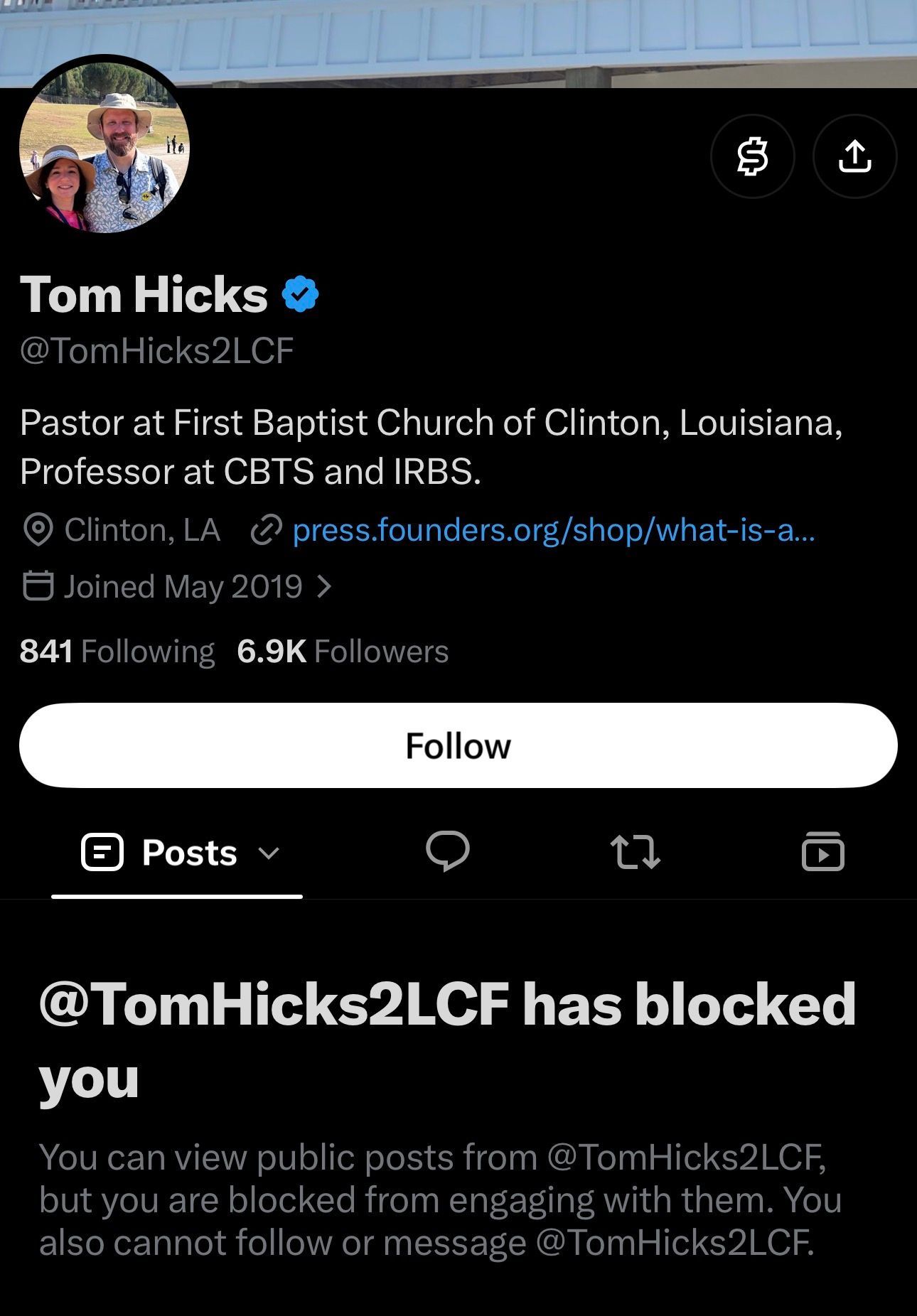
The author of What Is a Reformed Baptist? gives baptism four senses — but the engine is allegory's, and his own confession already ruled on it. Tom Hicks — a confessional Reformed Baptist pastor whose very handle, @TomHicks2LCF, flies the Second London flag — recently offered on X what he weirdly called "the fourfold sense of Christian baptism." Four numbered senses, each pinned to a medieval label: immersion as a sign of union with Christ (literal); a sign of Christ's death and resurrection (allegorical); a sign of the believer's death to self and new life (tropological); a sign of the believer's passing from this world into the next (anagogical). Patrick Schreiner — author of The Four Senses of Scripture, the most prominent recent case for recovering the quadriga — welcomed it: a smile emoji and a "thank you" GIF. The gesture is light. It is also telling, and it is why this small thread from X repays a longer look. The author of the retrieval's flagship book has just cheered the fourfold method as it steps off the page. What was a claim about how biblical texts mean is now applied, with the movement's blessing, to how a sacrament means. I want to be careful not to pay this the wrong compliment. One could call the post creative and mean it warmly. It seems as if many confessional Reformed Baptists do. But the creativity is the whole problem, not a mitigating grace. A hermeneutic is a discipline: it constrains what a thing may be taken to mean and tells you when you have gone wrong. A heuristic is a generator: it prompts you to produce, and it never runs dry. The fourfold scheme, turned on baptism, constrains nothing. It generates — four slots, and an invitation to fill them. That a godly and able pastor can fill them so readily is not evidence the method works; it is evidence of what the method is. A scheme that can find its four senses in a text, in an ordinance, in a hymn, in a handshake, is not discovering four senses in any of them. It is running its apparatus, which will always yield four, because yielding four is what it was built to do. Not a bug — the feature. There is a name for the faculty at work. Pareidolia is the mind's readiness to see a face where there is only cloud; apophenia, its broader cousin, is the readiness to see connection where nothing is in fact connected. The quadriga laid over a sacrament is apophenia in its Sunday clothes — the familiar fourfold silhouette projected onto a subject that never asked for it. Baptism is not a text with a literal sense and three spiritual ones stacked above it. It is one sign, and it signifies richly: union, death and resurrection, new life, the hope of glory — all of it whole and undivided in a single thick redemptive-historical reading of the texts that give it (Rom. 6:3–5; Col. 2:12; 1 Pet. 3:21). Sorting that one meaning into four medieval bins does not enrich the meaning. It multiplies the bins. And then the thread did the argument's work for it. A reader, Mark Harrelson, noticed a gap: "5. For remission of sins. You missed that one." The fourfold scheme had left out something the Nicene Creed itself confesses of baptism — and a fifth item is an awkward thing to hand a fourfold sense. Hicks's answer has real theological content, and none of it is wrong: Christ procures remission at the cross, faith is the hand that receives it, and baptism asserts and confirms it to the believer. Hold that sacramentology; it is sound. Then watch what the method makes him do with it. Remission, he said, is "contained in the allegorical sense." The four senses did not produce remission; challenged, they absorbed it, folding a fifth doctrine into a slot already holding another. That is not a fourfold reading yielding its riches. It is an elastic container stretching to swallow whatever the objection supplies. If the allegorical sense can take on remission after the fact — remission, which has no quarrel with the "death and resurrection" already sitting in that bin — then the "senses" are not distinct compartments of meaning the sacrament yields. They are labels roomy enough to relabel. Press them and they expand; and a scheme that expands on demand has stopped dividing anything at all. Remission was never a missing fifth sense. It was already inside the one meaning of baptism, exactly where union and new life and hope already were. The category error is the surface. The deeper problem is confessional — and here the irony turns tragic. And the tragedy is only multiplied by however many Reformed Baptists it influences to downplay or contradict the this foundational confessional hermeneutic. Hicks is no bystander to the Second London; he wrote the book on it. In What Is a Reformed Baptist? he argues that Reformed Baptist identity is confessional identity — that to be a faithful Reformed Baptist is to hold the historic confessions, and the Second London above all. The man who taught a generation that being Reformed Baptist means holding this confession has now read baptism in a way the confession forecloses. He cannot wave the objection off, because it is his own standard, in his own book, that raises it. The Second London, with Westminster, declares that the true and full sense of any Scripture "is not manifold, but one." Those four words do logical work. "Not manifold" is a denial — not a ranking, not a subordination, but a denial — of multiple senses as such. It denies the genus. And the quadriga, a theory of four senses, is the most prominent species of that genus. The denial of a genus necessarily contains the denial of its species: deny that Scripture's sense is manifold, and you have denied, in the same breath, the fourfold scheme that is manifoldness's flagship. To confess 1.9 is to have already declined the quadriga — and having declined it for texts, one has declined it for whatever else the fourfold silhouette gets projected onto next. This is no novel reading of the phrase. It is the plain force of "not manifold," and it is how the confessional tradition treated the question. Tyndale, Perkins, Whitaker, Leigh, and Turretin did not say the spiritual senses must be kept subordinate to the literal. They said Scripture has one sense. The men who wrote "not manifold, but one" were denying multiplicity, not tidying it into a hierarchy. The confession does not only deny; it directs. Having called the true and full sense "not manifold, but one," the same paragraph says how the one sense is found: it "must be searched and known by other places that speak more clearly" — Scripture set beside Scripture, read under the analogy of faith. That is the confessional method for establishing a doctrine's full meaning, baptism included: not four bins to be filled, but the gathering of every text that bears on the sign into one coherent teaching. Remission belongs to the doctrine of baptism not because it can be tucked into an allegorical slot, but because Scripture, searched and known — Acts 2:38 beside Romans 6, and the creed's "one baptism for the remission of sins" — teaches it as part of the one thing baptism signifies. The analogy of faith is intertextual, not fourfold. What was offered under the name of depth is a medieval grid standing in for the confession's own method — and standing in for it poorly, since the grid had no slot for remission until someone pointed out the lack. There is a stock reply that this is simply not what the Confession means. But asserting that "not manifold, but one" leaves room for other distinct senses is not an argument; it is the very thing to be shown, and it owes three unpaid debts: an alternative reading of the actual words "not manifold, but one"; historical evidence that the framers meant to leave a door open for distinct senses; and some account of the genus–species relation on which a man may deny multiple senses and keep four of them. Until those are produced, the four words stand. So — allegorist? Not by conviction. Despite recommending allegory to frame a spiritual sense for the doctrine of baptism, Hicks would reject the label, and the confession he wrote a book to commend rejects it for him. The charge was never that he holds allegory's creed. It is that he has borrowed allegory's engine and set it running against the very standard he taught the churches to keep. The soft retrieval of the quadriga keeps arriving at the same wall, and it arrives now in a new field. Whether the fourfold sense is offered for a passage or for the ordinance of baptism, the confessional verdict does not move. The waters are rich — rich with union, death, resurrection, new life, remission, and the hope of passing through the last judgment into glory. But that is the fullness of one sense, not the sum of four. There is a leaven here, and it is spreading. The manifold sense of Scripture, long resisted among Baptists, has unfortunately found a welcome among some Reformed Baptist pastors and seminary professors — and now it has jumped the tracks a second time, from the senses of a text to the senses of a doctrine. A fourfold sense of baptism today; a fourfold sense of the Supper, the church, the covenants tomorrow. Each step is greeted as recovery, as depth. But none of it is the confessional framing of the analogy of faith, and a little leaven leavens the whole lump. What spreads here is not a retrieval. It is a grid mistaken for a method, and a fad mistaken for a tradition. It may be someone's tradition. But not ours. Heuristic, not hermeneutic. Not manifold, but one. We distinguish. POST SCRIPT... Pastor Tom kindly unblocked me and replied to my X article: "Thank you for the post and the generous interaction. Allegory in the medieval usage was often severed from the meaning of the text and generated fresh meaning independent of the what the Word of God actually said. When the Reformers opposed allegory, that is what they opposed. But at other times, the Reformers employed allegory, but only when it was anchored in the one meaning of the text. Benjamin Keach was a faithful English Particular Baptist pastor who signed the Second London Confession of Faith. He wrote a massive interpretive tome titled Tropologia in which he proceeded to open the allegorical/typological, metaphorical, and tropological senses of Scripture. You can research it using AI and Google. He did not believe the one sense of Scripture is limited to the literal sense but expanded to typology and allegory and tropology. The same method of interpretation is evident from the preaching of Charles Spurgeon (often maligned by literalists). But these Reformed Baptist brethren didn't see any conflict with our venerable confession because there isn't any. It is found throughout our Reformed and Particular Baptist heritage. Tolle lege. The procedure of looking for the meaning of the text, how it points to Christ, how to apply it, and how it gives us hope for the future, arises from studying the way that Jesus and the apostles themselves studied the Bible. While I don't have space to work it out fully here, consider just one example from the author of Hebrews which is Paul, in case you were wondering. :) See Hebrews 12:5-6 and the manner in which the preacher handles the biblical interpretation of Prov 3:11-12. Context shows a fourfold sense. First, there is the plain sense. This is the truth that God trains or disciplines His sons. Second, there is the Christ-centered sense. God led Christ to the cross (Heb 12:2), and Christ learned obedience through suffering (Heb 5:8). He did this for us as our substitute and example. Third, there is the applied sense. God loves us, Christ teaches us how to suffer in love; therefore, in light of Christ, we can embrace suffering and persevere in love without becoming weary or fainthearted, knowing we are being made like Christ (Heb 12:11). Fourth, there is the final or heavenly sense. The goal of our training in sanctification is ultimately to see the Lord (Heb 12:14). Many other such examples of the Bible's interpretation of the Bible in this way could be shown. There is only one sense of the text. But that one sense is often though not always multilayered with many necessary implications." To which I replied: "Appreciate you for unblocking me to exchange replies. While some people decry this app, i find you get what you invest in it. Your input is greatly appreciated. I understand you may write more wherever you choose is best. My good faith yet pointed response will be a short list of where I consider you unhelpfully and sloppily blurring the lines logically, biblically, and confessionally: The first and most obvious: the 4fold sense as a tool for reading texts, versus interpreting a doctrine (e.g., baptism). A figure of speech, versus a second sense. Typology, versus invented allegory. Preaching a text, versus interpreting a text. Rejecting a method’s abuses, versus rejecting the method; illicit to overlay even the quadriga’s structure on our confession. And a big one: the implications of one meaning, versus four different senses or meanings." Please, stay tuned and be on the lookout for an episode of the Urban Puritano Podcast for a discussion of these issues.
By Roberto Gazga August 9, 2026
The body content of your post goes here. To edit this text, click on it and delete this default text and start typing your own or paste your own from a different source.
By Urban Puritano August 8, 2026
The body content of your post goes here. To edit this text, click on it and delete this default text and start typing your own or paste your own from a different source.

Check the Urban Puritano Shop