Roberto Gazga • May 15, 2026

Rechazo Confesional y Racional: El Retroceso Insostenible de la Cuadriga

Rechazo Confesional y Racional:

El Retroceso Insostenible de La Cuadriga


¡O, Quadriga Qua Quadriga!


La cuadriga de los cuatro sentidos es irreconciliable tanto con las declaraciones confesionales reformadas sobre el sentido de la Escritura como con la razón. Mientras que la cuadriga transforma el sentido literal en los sentidos espirituales alegórico, tropológico y anagógico como la hermenéutica oficial de la Iglesia Católica Romana, algunos que se identifican como protestantes, evangélicos y confesionales están intentando una reimaginación de la cuadriga como cuatro ángulos, cuatro sensibilidades o cuatro preguntas.


Sin embargo, confesiones como la WCF y la 2LBCF comparten un lenguaje que aborda esta incompatibilidad. Ante las preguntas respectivas sobre si algún pasaje bíblico en particular tiene múltiples significados y si algún pasaje bíblico en particular tiene solo un significado, las respuestas confesionales son explícitas:


(1) No, el verdadero sentido de la Escritura no es múltiple. Esta negación del sentido múltiple incluye necesariamente el rechazo de la cuadriga, ya que su sentido cuádruple es un ejemplo de tal sentido múltiple.(2) Sí, el sentido verdadero y pleno de cualquier Escritura es uno solo.


Estas declaraciones confesionales explícitas hacen que el empleo de la cuadriga —ya sea en su forma rehabilitada o en una integración parcial en la hermenéutica reformada confesional— no solo sea innecesariamente problemático, sino insuperable. Abogar por su uso bajo el pretexto de leer las Escrituras como lo hacían los apóstoles o de leerlas de manera cristocéntrica es, por tanto, un claro (si no deshonesto) retroceso en el compromiso confesional histórico. Después de todo, los teólogos y escritores reformados anteriores a la WCF y la 2LBCF poseían de hecho en su gramática hermenéutica el significado, la aplicación y la distinción entre el sentido múltiple y el sentido único. 


Estos teólogos más antiguos, como William Whitaker, e incluso los más antiguos que los influyeron, como William Tyndale, argumentaron en contra del sentido múltiple que la cuadriga concebía y no fueron menos cristocéntricos en la interpretación de las Escrituras ni menos conscientes en armonizarlas por ello.Los autores bíblicos nunca suplantan el sentido literal de la Escritura mediante sentidos espirituales impuestos externamente de manera dualista. A pesar de las actuales divagaciones metafísicas hacia visiones “gruesas” del lenguaje sustitutivo por parte de algunos defensores académicos reformados confesionales y partidarios de la viabilidad de la cuadriga como hermenéutica bíblica, la confesión mantiene su rechazo del sentido múltiple. Irónicamente, ellos quieren aplicar el concepto de que las palabras bíblicas son símbolos de cosas de manera más o menos fija, pero se apresuran a reinterpretar la negación explícita de la confesión del sentido múltiple de la Escritura para incluir la compatibilidad de la cuadriga con la confesión. El resultado es una confesión que niega y afirma el sentido múltiple al mismo tiempo. ¡Hasta ahí llega la idea de que las palabras significan cosas!


Esta defensa y respaldo de la redefinición de la cuadriga como cuatro ángulos, cuatro sensibilidades o cuatro preguntas puede optar por basar superficialmente su abandono del rechazo confesional del sentido múltiple de la cuadriga en el uso figurado que hace el apóstol Pablo de “letra” y “espíritu” en 2 Corintios 3:6. Debemos recordar que existe una gran tradición de invocar rápidamente esto como un ejemplo que justifica hablar de manera vaga y superficial de una bifurcación entre el sentido literal y el sentido espiritual. Una vez hecha esta bifurcación, los sentidos espirituales de la cuadriga emergen de su letargo literal. Pero ni la confesión ni los autores bíblicos hacen tal movimiento.


Los escritores modernos que defienden o respaldan la rehabilitación de la cuadriga para representar una lectura correcta de la Escritura son, en el mejor de los casos, deshonestos, y en el peor, mentirosos. Una tercera posibilidad, más generosa, es que estos eruditos sean dolorosamente superficiales, dada la historia de la negación confesional del sentido múltiple en obras polémicas teológicamente más precisas, como Una Disputa sobre la Sagrada Escritura de William Whitaker.


Dado que la cuadriga manifiestamente no es confesional, esto plantea una pregunta adicional: ¿Es el uso de la cuadriga un movimiento hermenéutico racional que deben hacer tanto los instruidos como los no instruidos? ¿Producirá la cuadriga en cuanto tal el sentido verdadero y pleno de la Escritura? Siguiendo la naturaleza cuádruple de la cuadriga como hermenéutica bíblica, preguntamos:


Si la interpretación bíblica debe producir un sentido cuádruple de la Escritura, ¿por qué cuatro? Eso es arbitrario. Sin embargo, no toda arbitrariedad es mala. En Estados Unidos, por ejemplo, existe una preocupación perenne por la educación histórica en las escuelas públicas. ¿Cómo pueden los maestros cubrir tanto material requerido de manera atractiva que fomente el pensamiento crítico? El Método de las Cuatro Preguntas (4QM) se desarrolló precisamente para eso y para funcionar necesariamente dentro de los límites de los estándares nacionales de educación. Las preguntas son:


  1. ¿Qué sucedió?
  2. ¿Qué pensaban ellos?
  3. ¿Por qué entonces y allí?
  4. ¿Qué pensamos nosotros al respecto?

¿Podrían haber sido diferentes estas preguntas? En última instancia, sí, podrían haberlo sido. La justificación de su arbitrariedad anidada es básicamente el contexto de los estándares educativos de secundaria y la elección de un marco que pudiera usarse para planificar, enseñar y evaluar eficazmente los cursos de historia en la escuela secundaria.


La historia de la cuadriga no estuvo bajo tales limitaciones. Primero hubo una bifurcación dualista entre los sentidos literal y espiritual. Luego se añadieron otros dominios de significado a lo largo de la historia interpretativa. La vacilación entre dos y tres sentidos espirituales además del literal continuó más o menos hasta que el Doctor Angélico consolidó su significado escolástico cuádruple. A pesar de su arbitrariedad anidada —ya sea para reflejar las virtudes cristianas de fe, esperanza y amor con los sentidos espirituales de la cuadriga o, más tarde en la historia hermenéutica, para alinearse con formulaciones teológicas más profundas que la letra de la Escritura puede proporcionar—, hay que admitir que sigue siendo en última instancia arbitraria. El número total de sentidos podría ser menor o mayor si tal marco sirviera a algún otro propósito ad hoc o a ningún propósito relacionado con la interpretación.


Además, si la interpretación bíblica no siempre debe producir un sentido cuádruple de la Escritura, ¿por qué no? Eso es caprichoso. Al menos la unidad didáctica del 4QM tiene que cubrir siempre las cuatro preguntas. Ni siquiera se afirma lo mismo del sentido cuádruple de la cuadriga. Nada menos que Tomás de Aquino enseñó que a veces el sentido literal era suficiente para detenerse porque ya cubría alguna verdad espiritual. Los pro-cuadriguistas protestantes dicen que no todo texto de la Escritura necesariamente siempre puede tener 4 sentidos, al igual que la palabra “set” en inglés no tiene que significar siempre sus 464 sentidos posibles cada vez que se usa. El contexto determina el significado de las palabras fuera de la Biblia, pero parece que, además del contexto, la ambivalencia y la subjetividad del intérprete proporcionan la respuesta definitiva sobre por qué la Escritura no siempre debe producir un sentido cuádruple. Este tipo de principio tiene la consecuencia de llevar a algunos cuadriguistas a admitir extrañamente que algunas porciones de la Biblia carecen de sentido espiritual. Patrick Schreiner, por ejemplo, declaró recientemente: “Creo que se puede ver el sentido espiritual en el Nuevo Testamento a veces”.


Parecería, entonces, que ya sea un marco hermenéutico de dos, cuatro o más de cuatro sentidos y la interpretación de la Escritura es en última instancia arbitraria y completamente caprichosa. ¿Cómo puede mantenerse racionalmente tal método?


Ningún método de hermenéutica bíblica que sea caprichoso o arbitrario es racionalmente aceptable. La cuadriga en cuanto tal queda descalificada como hermenéutica racionalmente aceptable por ser tanto caprichosa como arbitraria.


Esto puede dejar el entusiasmo por el reempaquetado, redefinición, rehabilitación y recuperación de la cuadriga para los protestantes en general —y para los reformados confesionales en particular— en una posición racionalmente precaria. ¿Por qué el mismo defecto racional que afecta a la cuadriga en cuanto tal no constituiría una píldora venenosa papista para la cuadriga revivida como cuatro ángulos, cuatro sensibilidades y cuatro preguntas? Manténganse confesionales, amigos míos.


Share
By Urban Puritano August 23, 2026
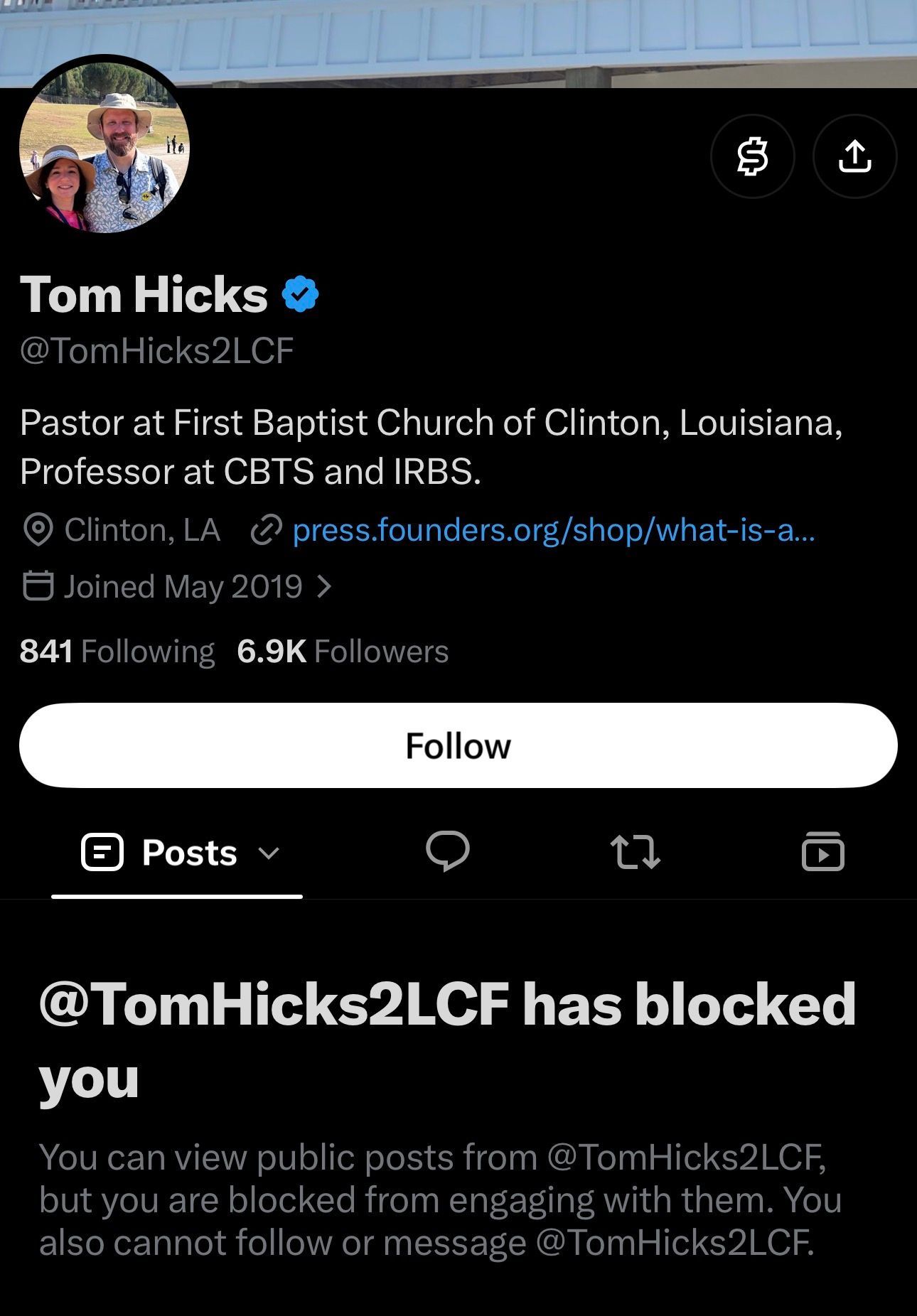
The author of What Is a Reformed Baptist? gives baptism four senses — but the engine is allegory's, and his own confession already ruled on it. Tom Hicks — a confessional Reformed Baptist pastor whose very handle, @TomHicks2LCF, flies the Second London flag — recently offered on X what he weirdly called "the fourfold sense of Christian baptism." Four numbered senses, each pinned to a medieval label: immersion as a sign of union with Christ (literal); a sign of Christ's death and resurrection (allegorical); a sign of the believer's death to self and new life (tropological); a sign of the believer's passing from this world into the next (anagogical). Patrick Schreiner — author of The Four Senses of Scripture, the most prominent recent case for recovering the quadriga — welcomed it: a smile emoji and a "thank you" GIF. The gesture is light. It is also telling, and it is why this small thread from X repays a longer look. The author of the retrieval's flagship book has just cheered the fourfold method as it steps off the page. What was a claim about how biblical texts mean is now applied, with the movement's blessing, to how a sacrament means. I want to be careful not to pay this the wrong compliment. One could call the post creative and mean it warmly. It seems as if many confessional Reformed Baptists do. But the creativity is the whole problem, not a mitigating grace. A hermeneutic is a discipline: it constrains what a thing may be taken to mean and tells you when you have gone wrong. A heuristic is a generator: it prompts you to produce, and it never runs dry. The fourfold scheme, turned on baptism, constrains nothing. It generates — four slots, and an invitation to fill them. That a godly and able pastor can fill them so readily is not evidence the method works; it is evidence of what the method is. A scheme that can find its four senses in a text, in an ordinance, in a hymn, in a handshake, is not discovering four senses in any of them. It is running its apparatus, which will always yield four, because yielding four is what it was built to do. Not a bug — the feature. There is a name for the faculty at work. Pareidolia is the mind's readiness to see a face where there is only cloud; apophenia, its broader cousin, is the readiness to see connection where nothing is in fact connected. The quadriga laid over a sacrament is apophenia in its Sunday clothes — the familiar fourfold silhouette projected onto a subject that never asked for it. Baptism is not a text with a literal sense and three spiritual ones stacked above it. It is one sign, and it signifies richly: union, death and resurrection, new life, the hope of glory — all of it whole and undivided in a single thick redemptive-historical reading of the texts that give it (Rom. 6:3–5; Col. 2:12; 1 Pet. 3:21). Sorting that one meaning into four medieval bins does not enrich the meaning. It multiplies the bins. And then the thread did the argument's work for it. A reader, Mark Harrelson, noticed a gap: "5. For remission of sins. You missed that one." The fourfold scheme had left out something the Nicene Creed itself confesses of baptism — and a fifth item is an awkward thing to hand a fourfold sense. Hicks's answer has real theological content, and none of it is wrong: Christ procures remission at the cross, faith is the hand that receives it, and baptism asserts and confirms it to the believer. Hold that sacramentology; it is sound. Then watch what the method makes him do with it. Remission, he said, is "contained in the allegorical sense." The four senses did not produce remission; challenged, they absorbed it, folding a fifth doctrine into a slot already holding another. That is not a fourfold reading yielding its riches. It is an elastic container stretching to swallow whatever the objection supplies. If the allegorical sense can take on remission after the fact — remission, which has no quarrel with the "death and resurrection" already sitting in that bin — then the "senses" are not distinct compartments of meaning the sacrament yields. They are labels roomy enough to relabel. Press them and they expand; and a scheme that expands on demand has stopped dividing anything at all. Remission was never a missing fifth sense. It was already inside the one meaning of baptism, exactly where union and new life and hope already were. The category error is the surface. The deeper problem is confessional — and here the irony turns tragic. And the tragedy is only multiplied by however many Reformed Baptists it influences to downplay or contradict the this foundational confessional hermeneutic. Hicks is no bystander to the Second London; he wrote the book on it. In What Is a Reformed Baptist? he argues that Reformed Baptist identity is confessional identity — that to be a faithful Reformed Baptist is to hold the historic confessions, and the Second London above all. The man who taught a generation that being Reformed Baptist means holding this confession has now read baptism in a way the confession forecloses. He cannot wave the objection off, because it is his own standard, in his own book, that raises it. The Second London, with Westminster, declares that the true and full sense of any Scripture "is not manifold, but one." Those four words do logical work. "Not manifold" is a denial — not a ranking, not a subordination, but a denial — of multiple senses as such. It denies the genus. And the quadriga, a theory of four senses, is the most prominent species of that genus. The denial of a genus necessarily contains the denial of its species: deny that Scripture's sense is manifold, and you have denied, in the same breath, the fourfold scheme that is manifoldness's flagship. To confess 1.9 is to have already declined the quadriga — and having declined it for texts, one has declined it for whatever else the fourfold silhouette gets projected onto next. This is no novel reading of the phrase. It is the plain force of "not manifold," and it is how the confessional tradition treated the question. Tyndale, Perkins, Whitaker, Leigh, and Turretin did not say the spiritual senses must be kept subordinate to the literal. They said Scripture has one sense. The men who wrote "not manifold, but one" were denying multiplicity, not tidying it into a hierarchy. The confession does not only deny; it directs. Having called the true and full sense "not manifold, but one," the same paragraph says how the one sense is found: it "must be searched and known by other places that speak more clearly" — Scripture set beside Scripture, read under the analogy of faith. That is the confessional method for establishing a doctrine's full meaning, baptism included: not four bins to be filled, but the gathering of every text that bears on the sign into one coherent teaching. Remission belongs to the doctrine of baptism not because it can be tucked into an allegorical slot, but because Scripture, searched and known — Acts 2:38 beside Romans 6, and the creed's "one baptism for the remission of sins" — teaches it as part of the one thing baptism signifies. The analogy of faith is intertextual, not fourfold. What was offered under the name of depth is a medieval grid standing in for the confession's own method — and standing in for it poorly, since the grid had no slot for remission until someone pointed out the lack. There is a stock reply that this is simply not what the Confession means. But asserting that "not manifold, but one" leaves room for other distinct senses is not an argument; it is the very thing to be shown, and it owes three unpaid debts: an alternative reading of the actual words "not manifold, but one"; historical evidence that the framers meant to leave a door open for distinct senses; and some account of the genus–species relation on which a man may deny multiple senses and keep four of them. Until those are produced, the four words stand. So — allegorist? Not by conviction. Despite recommending allegory to frame a spiritual sense for the doctrine of baptism, Hicks would reject the label, and the confession he wrote a book to commend rejects it for him. The charge was never that he holds allegory's creed. It is that he has borrowed allegory's engine and set it running against the very standard he taught the churches to keep. The soft retrieval of the quadriga keeps arriving at the same wall, and it arrives now in a new field. Whether the fourfold sense is offered for a passage or for the ordinance of baptism, the confessional verdict does not move. The waters are rich — rich with union, death, resurrection, new life, remission, and the hope of passing through the last judgment into glory. But that is the fullness of one sense, not the sum of four. There is a leaven here, and it is spreading. The manifold sense of Scripture, long resisted among Baptists, has unfortunately found a welcome among some Reformed Baptist pastors and seminary professors — and now it has jumped the tracks a second time, from the senses of a text to the senses of a doctrine. A fourfold sense of baptism today; a fourfold sense of the Supper, the church, the covenants tomorrow. Each step is greeted as recovery, as depth. But none of it is the confessional framing of the analogy of faith, and a little leaven leavens the whole lump. What spreads here is not a retrieval. It is a grid mistaken for a method, and a fad mistaken for a tradition. It may be someone's tradition. But not ours. Heuristic, not hermeneutic. Not manifold, but one. We distinguish. POST SCRIPT... Pastor Tom kindly unblocked me and replied to my X article: "Thank you for the post and the generous interaction. Allegory in the medieval usage was often severed from the meaning of the text and generated fresh meaning independent of the what the Word of God actually said. When the Reformers opposed allegory, that is what they opposed. But at other times, the Reformers employed allegory, but only when it was anchored in the one meaning of the text. Benjamin Keach was a faithful English Particular Baptist pastor who signed the Second London Confession of Faith. He wrote a massive interpretive tome titled Tropologia in which he proceeded to open the allegorical/typological, metaphorical, and tropological senses of Scripture. You can research it using AI and Google. He did not believe the one sense of Scripture is limited to the literal sense but expanded to typology and allegory and tropology. The same method of interpretation is evident from the preaching of Charles Spurgeon (often maligned by literalists). But these Reformed Baptist brethren didn't see any conflict with our venerable confession because there isn't any. It is found throughout our Reformed and Particular Baptist heritage. Tolle lege. The procedure of looking for the meaning of the text, how it points to Christ, how to apply it, and how it gives us hope for the future, arises from studying the way that Jesus and the apostles themselves studied the Bible. While I don't have space to work it out fully here, consider just one example from the author of Hebrews which is Paul, in case you were wondering. :) See Hebrews 12:5-6 and the manner in which the preacher handles the biblical interpretation of Prov 3:11-12. Context shows a fourfold sense. First, there is the plain sense. This is the truth that God trains or disciplines His sons. Second, there is the Christ-centered sense. God led Christ to the cross (Heb 12:2), and Christ learned obedience through suffering (Heb 5:8). He did this for us as our substitute and example. Third, there is the applied sense. God loves us, Christ teaches us how to suffer in love; therefore, in light of Christ, we can embrace suffering and persevere in love without becoming weary or fainthearted, knowing we are being made like Christ (Heb 12:11). Fourth, there is the final or heavenly sense. The goal of our training in sanctification is ultimately to see the Lord (Heb 12:14). Many other such examples of the Bible's interpretation of the Bible in this way could be shown. There is only one sense of the text. But that one sense is often though not always multilayered with many necessary implications." To which I replied: "Appreciate you for unblocking me to exchange replies. While some people decry this app, i find you get what you invest in it. Your input is greatly appreciated. I understand you may write more wherever you choose is best. My good faith yet pointed response will be a short list of where I consider you unhelpfully and sloppily blurring the lines logically, biblically, and confessionally: The first and most obvious: the 4fold sense as a tool for reading texts, versus interpreting a doctrine (e.g., baptism). A figure of speech, versus a second sense. Typology, versus invented allegory. Preaching a text, versus interpreting a text. Rejecting a method’s abuses, versus rejecting the method; illicit to overlay even the quadriga’s structure on our confession. And a big one: the implications of one meaning, versus four different senses or meanings." Please, stay tuned and be on the lookout for an episode of the Urban Puritano Podcast for a discussion of these issues.
By Roberto Gazga August 9, 2026
The body content of your post goes here. To edit this text, click on it and delete this default text and start typing your own or paste your own from a different source.
By Urban Puritano August 8, 2026
The body content of your post goes here. To edit this text, click on it and delete this default text and start typing your own or paste your own from a different source.

Check the Urban Puritano Shop